
When it comes to optimizing performance for drifting or racing, choosing the right differential setup can make all the difference. Two popular options among enthusiasts are the spool differential and the welded differential. In this article, we’ll break down the differences, advantages, and drawbacks of each option to help you decide which is best for your vehicle.
What Is a Spool Differential?

A spool differential is a fixed component that permanently locks the two drive wheels together. In a spool, there is no differential action—both wheels rotate at the same speed at all times. This simple design ensures that power is evenly distributed, making it a favorite in dedicated track or drift cars.
Key Characteristics
- Consistent Power Delivery: Both wheels receive the same amount of power, which is ideal for straight-line acceleration.
- Simplicity: With few moving parts, spool differentials require minimal maintenance.
- Predictability: The fixed nature provides a consistent, predictable response during aggressive driving.
What Is a Welded Differential?
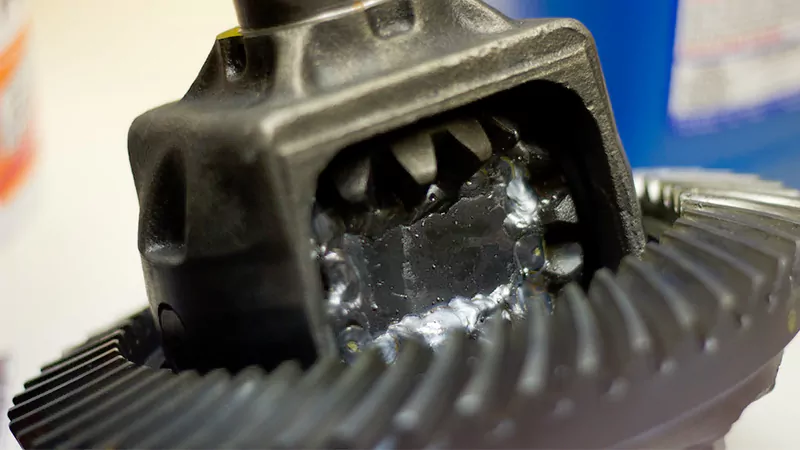
A welded differential is essentially a standard differential whose carrier has been permanently welded shut. This process locks the differential gears in place so that both wheels turn in unison. Unlike a spool, a welded diff is typically a DIY solution that transforms a stock open differential into a fixed unit.
Key Characteristics
- Cost-Effective: Welding a differential is often a less expensive upgrade compared to installing a spool.
- Simplicity: Similar to a spool, a welded diff offers a fixed torque split since both wheels are locked together.
- Irreversible Modification: Once welded, the differential cannot easily revert to its original function.
Comparing Spool and Welded Differentials
| Feature | Spool Differential | Welded Differential |
|---|---|---|
|
Power Delivery |
Even, consistent power to both wheels |
Even power, but depends on weld quality |
|
Cost |
More expensive |
Cheaper, DIY-friendly |
|
Installation |
Requires professional installation |
Can be done as a DIY modification |
|
Reliability |
Highly reliable, built for performance |
Dependent on welding quality, may fail under stress |
|
Maintenance |
Low maintenance, few moving parts |
No maintenance, but irreversible once welded |
|
Versatility |
Designed for racing/drifting, not street-friendly |
Similar functionality, but not reversible |
|
Reversibility |
Not reversible |
Permanent modification |
|
Best Use Case |
Professional drift or race cars |
Budget drift builds or temporary setups |
Which One Should You Choose?
The decision between a spool differential and a welded differential largely depends on your specific needs and budget:
- For Dedicated Performance Vehicles: If you’re building a drift or race car where performance consistency is paramount, a spool differential is generally the better choice due to its precision engineering and reliability.
- For Budget-Conscious Enthusiasts: If you’re looking for a cost-effective upgrade and are comfortable with a DIY modification (or have access to a skilled technician), a welded differential might be a viable option.
Conclusion
Understanding the pros and cons of each system can help you tailor your vehicle’s drivetrain to your specific performance goals. Whether you opt for the professionally engineered spool or the cost-effective welded solution, the right differential choice will undoubtedly enhance your drifting or racing experience.
