
If you’ve spent any time speccing out a serious off-road vehicle or working through a drivetrain upgrade, the question of differential locking comes up fast. And once it does, you’re immediately faced with a choice that’s more nuanced than it first appears: do you go with an automatic locking differential, or do you stick with a manual one?
Both systems exist to solve the same fundamental problem — open differentials allow wheels to spin freely relative to each other, which is great for cornering on paved roads but a liability the moment one tire loses traction. Locking mechanisms address that by forcing both wheels on an axle to rotate at the same speed, ensuring torque gets delivered even when one side is in the air or on a slick surface. But how each system gets there, and when it does so, differs significantly.
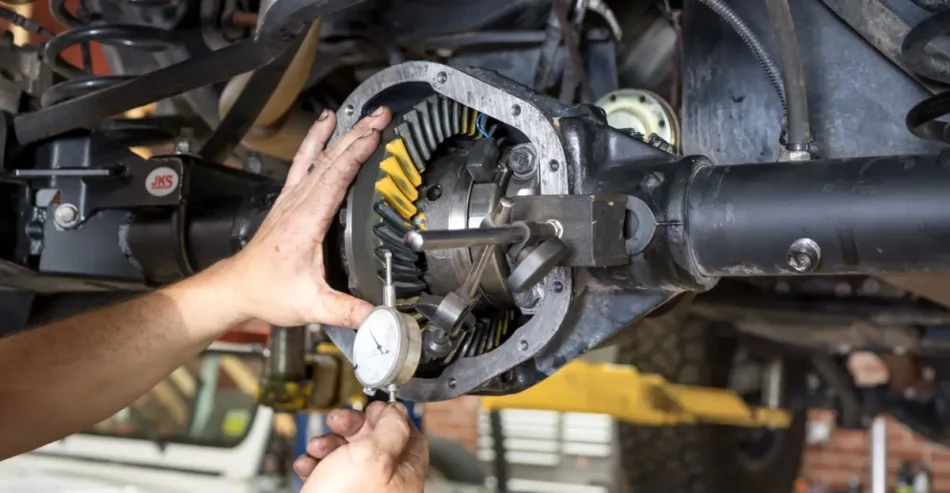
Why Open Differentials Create the Problem
To understand why locking matters, it helps to understand what happens without it.
The Torque Path of Least Resistance
In a standard open differential, torque always follows the path of least resistance. If one wheel lifts off the ground or hits a patch of mud with near-zero resistance, the differential sends power there instead of to the grounded wheel. The result: you’re spinning a tire that can’t move you forward while the wheel that could do useful work sits idle.
This is physics working against the driver. The differential isn’t malfunctioning — it’s doing exactly what it was designed to do. The design just wasn’t optimized for low-traction situations.
What Changes When You Add a Lock
A locked differential mechanically connects both axle shafts so they must rotate together. This eliminates the torque-seeking behavior of an open diff. Even if one wheel is completely off the ground, the other still receives full rotational input. In serious off-road or work vehicle applications, this is the difference between getting through a difficult section and getting stuck.
The trade-off is that locked differentials are not designed for normal road use. When cornering, your inside and outside wheels need to travel different distances — which is why differentials were invented in the first place. A locked diff forces them to travel the same distance, creating drivetrain binding, accelerating tire wear, and reducing steering predictability. Every locking system has to manage this trade-off in some way.
Manual Locking Differentials: Driver-Controlled and Mechanically Direct
Manual locking differentials — whether operated by a dash-mounted switch, a cable, or an air-actuated system — require the driver to engage and disengage the lock intentionally. You decide when you need the extra traction, you engage the system, and you disengage it once you’re back on stable ground.
Key Advantages of Manual Lockers
- Timing control: Experienced drivers can engage the lock before entering a difficult section, rather than reacting after the wheels start spinning. There’s no lag waiting for automation to detect slip.
- Mechanical simplicity: Fewer electronic components means fewer potential failure points. In harsh environments — water, mud, dust, impact — mechanical systems tend to outlast electronic ones.
- Predictable behavior: The lock engages and disengages exactly when you tell it to. There’s no risk of unexpected engagement on a hard surface or during cornering.
- Durability under sustained load: Heavy-duty work trucks, agricultural equipment, and purpose-built off-road platforms favor manual lockers precisely because they hold up under repeated high-torque cycles without degrading.
Limitations to Keep in Mind
- Requires driver knowledge and attentiveness to use correctly
- Engaging the lock while already in a deep wheel spin can cause shock loading on the drivetrain if not done carefully
- Not practical for vehicles operated by multiple drivers of varying experience levels
- Adds driver workload in situations where attention may already be divided
Automatic Locking Differentials: Reactive and Hands-Off
Automatic locking differentials remove the decision-making from the driver entirely. They monitor wheel speed differential or axle torque and engage the lock when a defined slip threshold is detected. Common designs include ratcheting mechanisms that engage under load and release when the vehicle coasts, as well as electronically controlled wet clutch systems used in more modern passenger and commercial vehicles.
Key Advantages of Automatic Lockers
- Zero driver input required: The system responds to conditions without any action from the operator. This makes it practical for multi-driver fleets and mixed-experience teams.
- Consistent traction delivery: In vehicles where the driver may not recognize a slip situation early enough to engage a manual lock, automatic systems provide a meaningful safety net.
- Integration with modern electronics: Advanced electronically controlled systems can selectively apply braking to slipping wheels, simulate locking behavior across multiple axles, and integrate with stability control for more precise engagement.
- Lower barrier to traction improvement: For consumer vehicles and light commercial applications, automatic systems deliver genuine capability gains without requiring operator training.
Limitations to Keep in Mind
- Reactive by nature — engagement happens after slip is detected, not before, which can cause brief momentum loss or trajectory shift
- More complex electronics introduce additional potential failure points in demanding environments
- Some older ratcheting designs can engage unexpectedly during normal cornering if the system misreads inputs
- Generally more expensive to repair or replace when failure does occur
Auto vs Manual Diff Lock: Side-by-Side Comparison
The table below summarizes the core differences between the two systems across the criteria that matter most to drivetrain engineers, fleet managers, and serious off-road builders.
| Criteria | Manual Diff Lock | Automatic Diff Lock |
|---|---|---|
|
Engagement control |
Driver-initiated |
System-initiated (reactive) |
|
Engagement timing |
Before slip occurs |
After slip is detected |
|
Mechanical complexity |
Lower |
Higher |
|
Electronic dependency |
Minimal |
Moderate to high |
|
Driver skill required |
Yes |
No |
|
Performance under sustained load |
Excellent |
Good to excellent |
|
Risk of road surface binding |
Low (driver controls timing) |
Moderate (especially older designs) |
|
Best application |
Dedicated off-road, heavy work platforms |
Mixed-use, multi-driver fleets |
|
Repairability in remote environments |
Easier |
More complex |
|
Typical cost to service |
Lower |
Higher |
This comparison isn’t about declaring a winner — it’s about identifying which system’s strengths align with your specific operating conditions.
Which System Is Right for Your Application?
There’s no universal answer to the auto versus manual question. The right choice depends on how and where the vehicle is actually being used.
Dedicated Off-Road and Heavy Work Platforms
For dedicated off-road vehicles, competition rigs, and heavy-duty work platforms where the driver is experienced and conditions are severe, manual locking differentials remain the preferred option among drivetrain specialists. The control they offer is unmatched, and their mechanical robustness makes them more dependable in situations where electronic systems might be compromised by water, dust, or impact damage.
Mixed-Use and Multi-Driver Fleet Vehicles
For mixed-use vehicles, light commercial vehicles, and any application where multiple drivers of varying experience will operate the vehicle, automatic systems offer meaningful practical advantages. They deliver improved traction without requiring training or consistent operator attention.
Combination Approaches
In many serious builds, both philosophies appear in the same vehicle:
- A manual locker on the rear axle for when maximum traction is genuinely needed
- An automatic or limited-slip setup on the front to manage everyday conditions without constant driver input
- Electronic traction control layered on top to modulate behavior across different surfaces
This kind of tiered approach gives experienced operators the control they want while maintaining predictable behavior during normal driving.
What to Look for When Sourcing Locking Differentials
Not all locking differentials are built to the same standard, and sourcing decisions have a significant downstream impact on performance and longevity.
Critical Manufacturing Specifications
The following factors should be evaluated when speccing a locking differential for any serious application:
- Carrier strength and material grade: Determines how much torque the unit can handle before failure
- Gear hardness and tooth geometry: Affects load distribution and wear characteristics under repeated stress cycles
- Manufacturing tolerances: Tighter tolerances mean more predictable engagement behavior and longer service life
- Lock actuation design: Air, cable, electric — each has different response times and maintenance requirements
- Compatibility with modified drivetrains: OEM replacements may not match the output characteristics of a drivetrain that has been upgraded for higher torque
Replacement vs. Custom Specification
For vehicles operating in demanding conditions — high-torque diesel applications, heavy payloads, repeated articulation cycles — the differential specification needs to match the actual application, not just the OEM catalog number. Undersized components will fail under stress. Overspecified components add unnecessary cost and weight. Getting this right requires working with a manufacturer who can produce to specific requirements rather than a fixed product range.
A Practical Summary for Drivetrain Decision-Makers
The choice between automatic and manual differential locking comes down to three variables: operator experience, vehicle use profile, and environment.
- If the operator is experienced and conditions are severe: manual locking differential, rear axle minimum
- If the operator pool is mixed and consistent traction matters more than control precision: automatic or electronic locking differential
- If the vehicle operates across both road and off-road regularly: consider a combination setup with manual lock available on demand
In every case, the goal is the same — predictable, controllable power delivery to the ground, matched to the conditions you actually operate in.
At XinJin Auto Parts, we manufacture locking differentials and drivetrain components for both OEM replacement and custom specifications. If you’re working through a build requirement or need components produced to a specific application, contact us and we’ll work through it with you directly.
