
In the world of drivetrain engineering, traction is everything. Whether a vehicle is navigating loose gravel, mud, snow, or uneven terrain, the ability to maintain consistent power delivery to the wheels determines performance, safety, and control. This is where the concept of a locking differential becomes critical.
Most drivers are familiar with standard differentials, but fewer understand why locking differentials exist, how they function mechanically, and in what scenarios they become essential rather than optional. This guide breaks down the concept in a clear, practical way—covering working principles, types, advantages, limitations, and real-world applications.
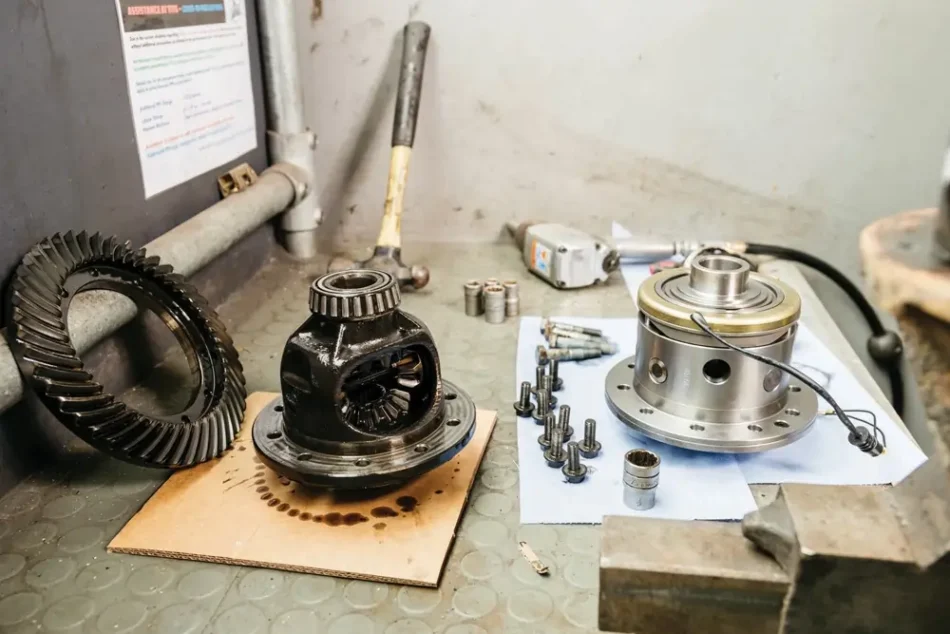
Understanding the Role of a Differential
To understand a locking differential, you first need to understand what a standard (open) differential does.
A differential is a gear system that allows the left and right drive wheels to rotate at different speeds while still receiving power from the engine. This is necessary when a vehicle turns, as the outer wheel must travel a longer distance than the inner wheel.
However, this design introduces a fundamental limitation: An open differential always sends power to the wheel with the least resistance.
In low-traction situations—such as when one wheel is on ice or lifted off the ground—this results in that wheel spinning freely, while the other wheel receives little or no usable torque. The vehicle becomes stuck, even though one wheel may still have grip.
What Is a Locking Differential?
A locking differential is designed to solve this exact problem.
It is a type of differential that can mechanically lock both axle shafts together, forcing both wheels on the same axle to rotate at the same speed regardless of traction conditions.
This means:
- Even if one wheel loses traction completely,
- The other wheel will still receive torque,
- Allowing the vehicle to continue moving.
In simple terms: A locking differential overrides the default behavior of an open differential and ensures equal power distribution to both wheels.
How Does a Locking Differential Work?
At the core of a locking differential is a mechanism that can engage or disengage a lock between the left and right axle shafts.
Under normal conditions, the differential behaves like a standard unit, allowing smooth turning. When traction is compromised, the locking mechanism engages, eliminating speed difference between the wheels.
There are two primary ways this locking action is triggered:
1. Automatic Locking
In automatic systems, the differential detects a speed difference between the wheels and engages the lock without driver input. This is typically achieved through internal mechanical components such as cams, gears, or clutch packs.
2. Driver-Selectable Locking
In selectable systems, the driver manually activates the lock using a switch or lever. The engagement can be controlled via:
- Electronic actuators (E-lockers)
- Air pressure systems (air lockers)
- Hydraulic systems
Selectable lockers provide greater control, especially in mixed driving conditions where full-time locking would negatively impact handling.
Types of Locking Differentials
Locking differentials are not a single, uniform design. In practice, they exist in several configurations, each engineered for different performance goals, driving conditions, and levels of control. Understanding these types is essential when selecting the right solution for a specific application.
Automatic Locking Differential
Automatic locking differentials engage without driver input. When a speed difference between the wheels is detected, internal mechanisms lock the axle shafts together to restore traction.
Common designs include:
- Mechanical locking differentials (cam and gear-driven systems)
- Ratcheting-style lockers (commonly found in off-road setups)
Note: These are often confused with limited slip differentials (LSD), but they are fundamentally different. LSDs limit slip progressively, while automatic lockers fully lock under certain conditions.
Advantages
- Immediate response to traction loss
- No need for driver intervention
- Reliable and mechanically simple
Disadvantages
- Harsh engagement, especially on pavement
- Noticeable noise (clicking or banging)
- Can negatively affect handling during turns
Selectable Locking Differential
Selectable locking differentials allow the driver to manually engage or disengage the lock as needed. Under normal driving conditions, the differential operates like an open unit, preserving smooth handling.
Common types include:
- Electronic Lockers (E-Lockers): Activated via an electric switch
- Air Lockers: Use compressed air to engage the locking mechanism
- Hydraulic Lockers: Less common, used in specialized applications
Advantages
- Full control over when the differential locks
- Maintains normal drivability when disengaged
- Ideal balance between on-road comfort and off-road capability
Disadvantages
- More complex system (wiring, air compressors, etc.)
- Higher cost compared to automatic lockers
- Requires driver awareness and proper use
Spool (Fully Locked Differential)
A spool is the simplest form of a locked differential. Instead of allowing any differentiation, it permanently connects both axle shafts, forcing them to rotate at the same speed at all times.
Common variations include:
- Full Spool: A solid unit replacing the differential entirely
- Mini Spool: Installed inside the existing differential carrier
- Welded Differential (“Welded Diff”): A modified open differential where gears are welded together
Advantages
- Maximum possible traction
- Extremely strong and durable
- Cost-effective in certain builds (especially welded setups)
Disadvantages
- Poor turning performance (severe tire scrubbing)
- Increased stress on axles and drivetrain components
- Not suitable for street use
Limited Slip Differential (LSD) — A Related but Different Solution
While not a true locking differential, the limited slip differential is often discussed alongside lockers because it addresses the same problem—loss of traction.
Instead of fully locking both wheels, an LSD limits the speed difference between them using internal resistance.
Common variations include:
- Clutch-Type LSD (Friction Plate): Uses clutch packs to transfer torque
- Torsen (Helical Gear LSD): Uses worm gears for torque biasing
- Viscous LSD: Uses fluid resistance (less common in modern performance setups)
Advantages
- Smooth and progressive engagement
- Better handling characteristics on-road
- No driver input required
Disadvantages
- Cannot achieve full lock
- Less effective in extreme off-road conditions
- Performance may degrade over time (especially clutch-type)
Key Takeaway
Each type of differential represents a different balance between traction, control, durability, and driving comfort.
- Automatic lockers prioritize simplicity and traction
- Selectable lockers offer maximum flexibility
- Spools deliver uncompromising performance at the cost of usability
- LSDs provide a middle ground for mixed driving conditions
Choosing the right type depends not only on the vehicle, but also on how and where it will be used.
Advantages of a Locking Differential
A locking differential is specifically engineered to solve one of the most fundamental limitations of a standard drivetrain: uneven traction between wheels. While its function is mechanically straightforward, the real-world benefits are significant—especially in demanding environments.
1. Maximum Traction in Low-Grip Conditions
The primary advantage of a locking differential is its ability to deliver consistent torque to both wheels, regardless of traction differences.
In an open differential, torque follows the path of least resistance. This means that if one wheel loses grip—on mud, ice, or loose gravel—it will spin freely while the other wheel receives little usable power. A locking differential eliminates this issue by forcing both wheels to rotate together.Lorem ipsum dolor sit amet, consectetur adipiscing elit. Ut elit tellus, luctus nec ullamcorper mattis, pulvinar dapibus leo.
Why it matters:
- Prevents single-wheel spin
- Maintains forward momentum
- Allows the vehicle to recover from traction loss
This makes it particularly valuable in off-road environments where uneven surfaces are common.
2. Superior Off-Road Capability
Locking differentials are widely regarded as essential equipment for serious off-road driving. Whether navigating rocks, sand, mud, or steep inclines, maintaining traction across both wheels is critical.
When one wheel becomes unloaded (for example, lifted off the ground during articulation), a locking differential ensures that the wheel still in contact with the terrain continues to receive power.
Practical benefits include:
- Improved climbing ability on uneven terrain
- Greater control in technical off-road situations
- Reduced likelihood of getting stuck
This is why many 4×4 vehicles and off-road builds prioritize locking differentials over other traction solutions.
3. Consistent and Predictable Power Delivery
By mechanically linking both axle shafts, a locking differential creates a more predictable drivetrain response under load.
Instead of reacting unpredictably to traction changes, the system delivers stable and uniform torque distribution, which improves driver confidence in challenging conditions.
This results in:
- Better throttle control
- Reduced hesitation when traction changes suddenly
- More stable vehicle behavior in extreme scenarios
4. Increased Capability in Extreme Conditions
In environments such as deep snow, wet clay, or loose sand, traction can vary dramatically between the left and right wheels. A locking differential ensures that this variation does not compromise the vehicle’s ability to move.
Unlike limited slip differentials, which rely on internal resistance and may struggle when one wheel has near-zero traction, a locking differential provides a true mechanical lock, making it far more effective in extreme situations.
5. Mechanical Simplicity and Reliability (for Certain Types)
Many locking differentials—especially automatic mechanical lockers—are relatively simple in design compared to electronically controlled traction systems.
With fewer electronic dependencies, they tend to offer:
- High durability under heavy load
- Reliable performance in harsh environments
- Reduced sensitivity to water, dust, or temperature extremes
This makes them a preferred choice in industries such as off-road racing, agriculture, and heavy-duty utility vehicles.
Final Thoughts
A locking differential is one of the most effective solutions for improving traction in challenging conditions. By mechanically linking both wheels on an axle, it ensures that power is not wasted on a slipping wheel but instead translated into usable movement.
However, like any engineering solution, it involves trade-offs. Understanding when and how to use a locking differential is just as important as understanding how it works. For drivers, builders, and distributors alike, this knowledge directly impacts performance, reliability, and overall vehicle capability.
If you are sourcing locking differential components or complete assemblies, XinJin Auto Parts is a direct manufacturer supplying consistent-quality drivetrain solutions for bulk orders. Please feel free to contact us now!
