
For the dedicated BMW enthusiast, the phrase “The Ultimate Driving Machine” is not merely a marketing slogan; it is a mechanical promise. It represents a commitment to rear-wheel-drive balance, telepathic steering, and a chassis that communicates every ripple of the asphalt. However, there is a silent component nestled within the rear subframe that often determines whether a BMW lives up to this promise or falls short during spirited driving: the Limited Slip Differential (LSD).
In recent decades, many non-M BMW models have left the factory equipped with a standard “open” differential. While efficient for the average commuter, an open differential is the technical bottleneck that prevents a high-torque BMW engine from effectively transferring power to the road. For workshops, parts distributors, and owners looking to restore or enhance their vehicle’s soul, understanding the nuances of the BMW LSD is the first step toward automotive excellence.
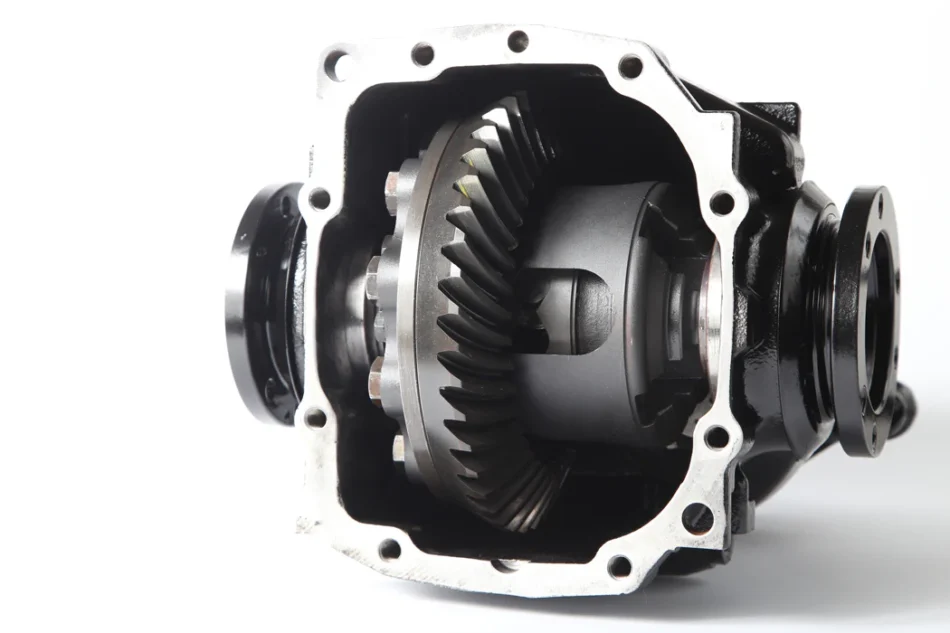
Why an LSD Matters
To understand the necessity of a BMW Limited Slip Differential, one must first confront the inherent flaw of the open differential. In a turn, the outside wheel must travel a greater distance than the inside wheel. A differential allows these wheels to rotate at different speeds while receiving power.
The problem lies in torque distribution. An open differential always sends equal torque to both wheels. If one wheel loses traction—such as the inside wheel lifting during a hard corner or a tire hitting a patch of wet pavement—the total torque applied to the ground is limited by the wheel with the least amount of grip. This leads to the frustrating “one-wheel peel,” where the engine’s power is wasted spinning a single tire while the car fails to accelerate.
Modern BMWs attempt to mask this with electronic systems like Active Differential Brake (ADB-X). While these systems use the brakes to slow a spinning wheel, it is a reactive, heat-intensive process that lacks the fluidity of a mechanical solution. A true mechanical LSD is proactive; it manages torque distribution through physical friction or gear geometry before the slip becomes a problem.
BMW LSD Types
BMW has utilized various differential technologies across different chassis generations, from the classic E30 to the modern G80 M3. Choosing the right unit requires a deep understanding of these mechanisms.
| LSD Type | Operating Principle | Main Advantages | Main Limitations | Best For |
|---|---|---|---|---|
|
Clutch-Type LSD |
Uses friction plates and pressure ramps to lock the axle shafts under load |
Strong locking effect, predictable under hard acceleration, highly suitable for track and motorsport use |
Requires regular maintenance, clutch plates wear over time, may produce chatter at low speed |
Track builds, drifting, high-performance BMW applications |
|
Helical / Torsen LSD |
Uses internal gears to bias torque toward the wheel with more traction |
Smooth operation, low maintenance, quiet in daily driving, long service life |
Less effective if one wheel has almost no load or is fully lifted |
Street cars, daily-driven performance vehicles, fast road use |
|
Electronically Controlled LSD |
Uses sensors, software, and electronic actuation or brake intervention to manage torque distribution |
Fast response, integrated with DSC/ABS systems, adaptive to changing road conditions |
More complex diagnostics, higher system complexity, dependent on electronics and software calibration |
Modern BMW platforms, factory-integrated performance systems |
1. Clutch-Type (Salisbury) Differentials
- The Dynamics: When torque is applied, the internal ramps force the pressure rings against the clutch plates, locking the two axles together.
- The Benefit: It provides a predictable, mechanical feel that is highly tunable via ramp angles and clutch materials. It is the preferred choice for track-focused builds and professional drifting.
- The Maintenance: Because it relies on friction, the clutches will eventually wear. This requires periodic fluid changes with specific friction modifiers to prevent “chatter” during low-speed maneuvers.
2. Helical and Torsen (Gear-Type) Units
Commonly used in aftermarket upgrades (such as Wavetrac or Quaife), these rely on complex gear geometry rather than friction plates.
- The Dynamics: These are torque-biasing units that automatically shift power to the wheel with more resistance.
- The Benefit: They are virtually maintenance-free and silent. For a daily-driven 335i or M240i, a helical unit offers a massive upgrade in traction without any of the noise or service requirements of a clutch-type unit.
- The Limitation: In extreme cases where a wheel completely leaves the ground, a standard helical diff may lose its effectiveness unless it features a specialized internal biasing plate.
3. The Modern M-Active Differential
Current high-performance BMWs utilize an electronically controlled, multi-plate clutch system. This unit integrates with the car’s Central Intelligence ECU, adjusting the locking percentage from 0% to 100% in milliseconds based on throttle position, steering angle, and yaw rate. This is the pinnacle of BMW drivetrain engineering, offering a bridge between traditional mechanical grip and modern software precision.
Fitment and Compatibility
For distributors and professional workshops, managing inventory for BMW differentials requires precise knowledge of “Case Sizes.” BMW utilizes three primary housing sizes that dictate compatibility.
- Type 168 (Small Case): Typically found in four-cylinder models and the E36/E46 318i/320i. These are lightweight but have lower torque capacity.
- Type 188 (Medium Case): The most versatile size, found in the majority of 6-cylinder BMWs, including the E30 325i, E36 328i, and E46 330i. This is the primary market for LSD retrofits and performance upgrades.
- Type 210 (Large Case): Reserved for high-torque applications such as the M3, M5, and modern turbocharged N54/N55/B58 platforms. These units are heavy but can withstand immense power levels.
When sourcing parts, it is critical to identify whether the crown wheel is “bolted” or “welded.” Many BMW models manufactured after 2007 (such as the E90/E92 series) feature a welded ring gear, which requires specialized machining to install an LSD core—a vital detail for any procurement specialist.

BMW E46 Differential Ratio Guide: Everything You Need to Know
This comprehensive guide dives deep into everything you need to know about the BMW E46 differential ratios, with a special focus on the popular 3.45 ratio. We’ll cover stock ratios, compatibility, upgrade options, and how to choose the best setup for your driving goals.
The Transformative Impact on Handling and Value
Investing in a BMW Limited Slip Differential is not merely about preventing wheel spin; it is about redefining the vehicle’s dynamic envelope.
Enhanced Corner Exit and Stability
The most profound change occurs at the apex of a corner. As you apply throttle, an LSD-equipped BMW will “squat and go.” The power is directed to the outside wheel, which is under the most load, effectively pushing the car out of the turn with authority. This also improves high-speed stability, making the car feel more planted during rapid lane changes or under heavy braking on uneven surfaces.
Safety and All-Weather Capability
While often associated with performance, an LSD is a significant safety feature. In rain or snow, the ability to deliver torque to both rear wheels ensures that the car can find traction where an open-diff car would simply stall. This makes an LSD retrofit a practical upgrade for BMW owners in northern climates.
Commercial and Resale Value
In the used BMW market, “LSD-equipped” is one of the most powerful phrases a seller can use. For many enthusiasts, a 3 Series with a factory-optioned or professionally retrofitted LSD is worth a significant premium over a standard car. For distributors, offering high-quality LSD rebuild kits and complete assemblies addresses a consistently growing market segment.
Diagnosing and Maintaining the BMW Drivetrain
To ensure long-term reliability and peak performance (EEAT principles), proper maintenance is non-negotiable.
- Noise Identification: A low-pitched “whining” usually indicates bearing wear or incorrect gear backlash. A “clunking” or “chattering” during tight turns often points to exhausted friction modifiers in clutch-type units.
- Fluid Science: BMW LSDs require high-performance synthetic gear oils, typically 75W90 or 75W140. Using the wrong fluid can lead to premature clutch failure or excessive heat buildup.
- Installation Precision: Setting the “backlash” (the gap between the teeth of the ring and pinion) and the “bearing preload” requires precision to within 0.01mm. This is why professional installation is always recommended over a casual DIY approach.
Market Trends and Business Opportunities
The demand for BMW drivetrain components is surging as older chassis enter the “modern classic” phase and newer turbocharged models reach power levels that overwhelm their factory open differentials. We are seeing a shift where enthusiasts no longer settle for “e-Diff” software solutions; they are demanding the raw, mechanical reliability of a physical LSD. For businesses, this creates a lucrative opportunity to provide high-precision gear sets, differential carriers, and complete housing upgrades.
Final Thoughts
At the intersection of engineering and emotion lies the differential. It is the component that translates the engine’s fire into the wheels’ rotation. A BMW without a Limited Slip Differential is a car with its potential locked behind a technical compromise. By upgrading, you are not just changing a part; you are completing the vehicle’s design as it was always intended to be.
At XinJin Auto Parts, we are a dedicated factory focusing on the production of high-precision BMW drivetrain and performance components. If you require premium limited slip differentials or custom gear solutions for your business or project, please contact us today to discuss how our expertise can support your needs.
