
This guide explains what a limited-slip differential is, how it works internally, how it differs from open and locking differentials, the types available, and why lubrication plays a critical role in long-term performance.
Understanding the Role of a Differential
Before defining a limited slip differential, it’s important to understand the purpose of a standard differential.
A differential is a gear assembly located inside the axle housing. Its primary functions are:
- Transmitting torque from the driveshaft to the axle shafts
- Allowing left and right drive wheels to rotate at different speeds
When a vehicle turns, the outer wheel must travel farther than the inner wheel. If both wheels were forced to rotate at the same speed, tire scrub and drivetrain stress would occur. The differential prevents this by permitting speed variation between wheels.
The most common configuration in passenger vehicles is the open differential.
The Limitation of an Open Differential
An open differential distributes torque equally to both wheels—but with one critical limitation: torque follows the path of least resistance.
If one wheel loses traction (for example, on ice or mud), it can spin freely while the opposite wheel receives minimal usable torque. This is why a vehicle with one wheel on ice may struggle to move forward even though the other wheel is on dry pavement.
This behavior is mechanically normal, but it reduces traction and stability in low-grip conditions.
What Is Limited Slip Differential?
A limited-slip differential (LSD) is a type of differential designed to limit excessive speed difference between drive wheels when a traction imbalance occurs.
Unlike an open differential, an LSD can redistribute torque toward the wheel with greater traction. It does not fully lock both wheels together; instead, it allows normal differential action during turns while providing resistance when slip becomes excessive.
In practical terms:
- During normal driving, it behaves similarly to an open differential.
- When one wheel begins to spin, internal mechanisms create resistance.
- That resistance biases torque toward the wheel with grip.
The result is improved traction without sacrificing drivability.
How a Limited Slip Differential Works Internally
Although different designs exist, the operating principle remains consistent: introduce controlled resistance between axle shafts.
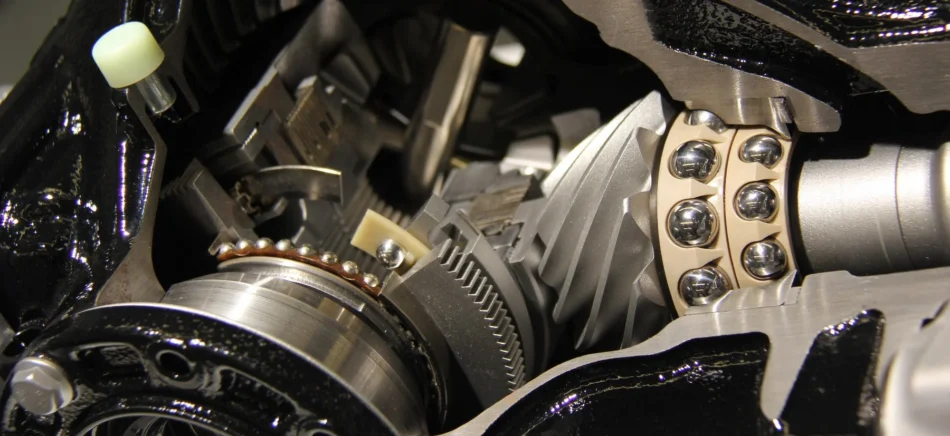
Inside the differential housing, LSD systems incorporate additional components beyond standard spider gears. These components create friction or mechanical resistance when speed difference increases.
The moment one wheel rotates significantly faster than the other, internal forces generate a torque bias. This bias transfers usable torque to the wheel with more traction.
The degree of torque transfer is often expressed as a torque bias ratio (TBR)—a measurement of how much torque can be sent to the wheel with grip compared to the slipping wheel.
Types of Limited Slip Differentials
Several LSD designs are used in automotive applications. The type determines behavior, maintenance requirements, and performance characteristics.
1. Clutch-Type Limited Slip Differential
Clutch-type LSDs use friction plates and clutch packs installed behind the side gears.
Operation principle:
- Under load, side gears press against clutch packs.
- Friction between plates resists the wheel speed difference.
- Increased torque increases clutch engagement.
Advantages:
- Strong and predictable torque transfer
- Adjustable preload in some applications
- Common in performance and motorsport vehicles
Maintenance considerations:
- Clutch plates wear over time
- Requires gear oil compatible with limited slip applications
- May require friction modifiers
Clutch-type LSDs are widely used in rear-wheel-drive performance vehicles and off-road builds.
2. Helical (Gear-Driven) Limited Slip Differential
Helical LSDs use worm gears or spiral-cut gears instead of friction plates.
Operation principle:
- Torque imbalance creates axial thrust forces inside gears.
- These forces generate internal friction.
- Torque is biased to the wheel with traction.
Advantages:
- No clutch plates to wear
- Smooth engagement
- Lower maintenance requirements
Limitations:
- Requires some resistance at both wheels to function
- Less effective if one wheel is completely airborne
Helical LSDs are common in modern performance sedans and hot hatchbacks.
3. Viscous Limited Slip Differential
Viscous LSDs use a sealed housing filled with silicone fluid.
Operation principle:
- Internal plates rotate within a viscous fluid.
- Increased speed difference causes fluid shear.
- Fluid thickens, limiting slip.
Advantages:
- Smooth and quiet operation
- Minimal mechanical wear
Limitations:
- Slower engagement compared to mechanical systems
- Heat can degrade fluid performance over time
Viscous designs were common in older AWD systems.
Limited Slip Differential vs Open Differential
Understanding this comparison clarifies why LSD systems are preferred in demanding conditions.
| Feature | Open Differential | Limited Slip Differential |
|---|---|---|
|
Torque distribution |
Equal but limited by least traction |
Biased toward higher-traction wheel |
|
Traction in snow/mud |
Limited |
Improved |
|
Corner exit acceleration |
Reduced stability |
Enhanced control |
|
Maintenance |
Minimal |
Depends on design |
|
Performance use |
Limited |
Suitable |
An LSD provides measurable traction benefits in both performance and utility applications.
Limited Slip Differential vs Locking Differential
A locking differential fully locks both axle shafts together when engaged. This ensures maximum traction but reduces drivability on pavement.
Key differences:
- LSD allows a limited speed difference.
- Lockers eliminate speed difference when engaged.
- LSD is ideal for mixed-use vehicles.
- Lockers are best for extreme off-road conditions.
For vehicles used daily but occasionally exposed to slippery terrain, LSD offers a balanced solution.
Why Gear Oil Matters in a Limited Slip Differential
Lubrication plays a more complex role in LSD systems than in open differentials.
In clutch-type LSDs, friction plates depend on specific friction characteristics to function correctly. If the gear oil’s friction profile is incorrect:
- The differential may chatter during low-speed turns.
- Clutch engagement may become abrupt or inconsistent.
- Premature wear can occur.
Many limited slip applications require gear oil formulated to meet API GL-5 standards with proper extreme-pressure additives. Some systems require additional friction modifiers to ensure smooth engagement.
Helical LSDs are less sensitive to friction modifiers but still rely on high-quality gear oil to protect gears and bearings under heavy loads.
Using incorrect lubricant can significantly reduce performance and durability.
Common Signs of Limited Slip Differential Wear
Like all drivetrain components, LSD units can degrade over time. Symptoms include:
- Excessive one-wheel spin
- Chatter or vibration during tight turns
- Grinding or whining noises
- Reduced traction performance
Regular oil changes and inspection of wear patterns inside the differential housing help extend service life.
Benefits of a Limited Slip Differential
Improved Traction
By redistributing torque during slip events, LSD enhances mobility in snow, mud, gravel, and wet conditions.
Enhanced Cornering Stability
Performance vehicles benefit from reduced inside wheel spin during corner exit acceleration.
Better Acceleration
Rear-wheel-drive vehicles gain improved straight-line traction under throttle.
Increased Control Under Load
Towing or carrying heavy loads places additional demand on the drivetrain. LSD improves torque management under these conditions.
Balanced Daily Drivability
Unlike locking differentials, LSD maintains smooth on-road handling.
When Is a Limited Slip Differential Worth It?
An LSD upgrade is worthwhile if:
You drive in regions with snow or rain
You require better off-road capability
You participate in track days
Your vehicle produces higher-than-stock torque
You operate fleet or utility vehicles requiring consistent traction
For automotive parts distributors and vehicle builders, limited slip differentials represent a high-demand upgrade category due to their versatility.
Maintenance Best Practices
To maximize LSD lifespan:
Use manufacturer-recommended gear oil
Replace fluid at appropriate intervals
Add friction modifier if required
Inspect for abnormal wear patterns
Address noise or chatter early
Proper lubrication is not merely preventive maintenance—it directly influences torque bias performance and overall reliability.
Final Summary
So, what is a limited-slip differential? It is a traction-enhancing differential design that limits excessive wheel speed difference by redistributing torque to the wheel with greater grip. It bridges the gap between open differentials and locking differentials, offering improved control without sacrificing drivability.
From performance applications to utility vehicles, LSD systems deliver measurable improvements in traction, stability, and acceleration. Understanding how they work—and how to maintain them properly—ensures long-term reliability and optimal performance.
If you are sourcing limited-slip differentials from a factory manufacturer, XJXPARTS produces high-quality drivetrain components for global markets. For technical inquiries or quotations, please contact us: https://www.differential-lsd.com/contacts/
