The Most comprehensive Central differential Differentials Explained

Central differential

Introduction

In the world of off-road and full-time four-wheel drive vehicles, the center differential is a component that’s frequently mentioned but often misunderstood. Many legendary 4WD models such as the Toyota Land Cruiser, Mercedes-Benz G-Class, and Land Rover Discovery proudly advertise features like “center diff lock,” yet few people understand what this really means. Far from being a marketing gimmick, the center differential plays a crucial role in balancing on-road drivability and off-road performance.

Structure and Types

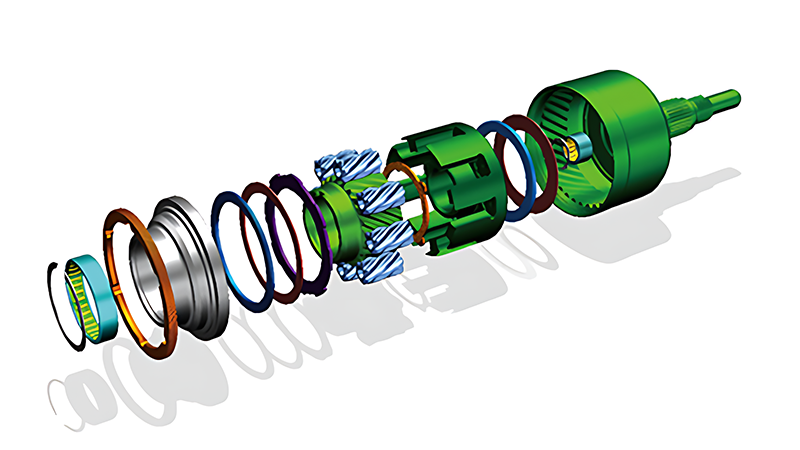
The center differential is located inside the transfer case, positioned between the front and rear driveshafts. Its primary function is to allow the front and rear axles to rotate at different speeds, particularly necessary during turns or when traction levels vary front to rear.

There are several types of center differentials used in different vehicle systems:

  • Open Differential: A basic gear-type diff that allows unrestricted speed difference between front and rear axles. It is smooth but prone to sending power to the axle with the least resistance.
  • Limited Slip Differential (LSD): Includes gear-based LSDs (like Torsen), viscous couplings, or clutch-type LSDs that limit the amount of slip between axles by automatically redistributing torque.
  • Locking Differential: A mechanical system that can be engaged to force both front and rear axles to rotate at the same speed, regardless of traction conditions.
Each of these systems has different benefits and use cases depending on the vehicle’s intended application.

How It Works

In a full-time 4WD system, the center differential is typically open during normal driving. This allows the front and rear axles to rotate at different speeds—essential during turns or when the tires are subject to different rolling resistance. For example, when making a turn, the front wheels usually travel farther than the rear, requiring different rotational speeds.

Without a center differential, this mismatch would result in drivetrain binding (also known as “torque wind-up”), which causes stress, jerky handling, and potential mechanical damage on high-traction surfaces.
However, in off-road or low-traction situations—such as mud, snow, or loose gravel—an open center differential can become a problem. If one axle loses traction entirely, the differential will send all the torque to that axle, causing the vehicle to get stuck.

This is where the center differential lock becomes essential. When engaged, it mechanically locks the front and rear driveshafts together, forcing equal torque distribution regardless of traction. This turns the full-time 4WD system into a behaviorally part-time 4WD mode and enables the vehicle to continue moving even if one axle is slipping.

Use Cases and Advantages

On-Road Driving

An open or limited-slip center differential ensures smooth, safe operation on paved surfaces, especially at high speeds or during cornering. It protects the drivetrain from excessive stress and ensures better handling.

Off-Road Conditions

In difficult terrain such as water crossings, rocky trails, deep snow, or sand, engaging the center diff lock becomes vital. It ensures torque is always sent to both axles—even if one is completely airborne or spinning on a slippery surface.

With Axle Differential Locks

When the center differential is locked, the vehicle only needs one wheel on each axle with traction to move forward. This is why hardcore off-road setups often include a center diff lock plus front and rear axle diff locks for maximum capability.
Conversely, if a vehicle only has a rear axle lock and the center differential is open, traction loss on a single front wheel could still result in immobilization. The synergy between a lockable center differential and axle lockers significantly enhances off-road performance.

Comparison with Other Drivetrain Systems

Here’s a comparison chart highlighting how center differentials fit into various four-wheel drive and AWD systems:
Drivetrain System Center Differential Lockable? Low-Range Gear (4LO)? Best Use Case
Full-Time 4WD (w/ Center Diff)
✅ Yes
✅ Optional
✅ Optional
Mixed use: highway + off-road
Part-Time 4WD
❌ No
✅ Manual Lock
✅ Yes
Off-road only, not for dry pavement
AWD (Automatic or Electronic)
✅ / ❌ Sometimes
❌ No
❌ No
City driving, rain, light snow
Symmetrical AWD (e.g., Subaru)
✅ (viscous/electric)
❌ / Electronic Sim
❌ / Rarely
Icy roads, light off-road
Although systems like Subaru’s AWD also have torque-splitting capabilities, they rely on viscous couplings or electronic clutches rather than mechanical locking differentials. These setups are effective in low-traction urban environments, but cannot match the rugged reliability of a proper center differential with mechanical locking and low-range gearing in extreme terrain.

Conclusion

The center differential is a critical component in full-time four-wheel drive systems. It enables a vehicle to remain controllable and efficient on-road, while offering formidable traction and torque distribution when off-road conditions demand it.
A lockable center differential, especially when combined with low-range gearing (4LO) and front/rear axle lockers, forms the foundation of a truly go-anywhere drivetrain. Vehicles like the Land Cruiser 80/100/200 series, Mercedes G-Wagen, and Land Rover Discovery 3/4 exemplify this layout.
While these systems may be heavier, more complex, and costlier to maintain, they offer unmatched versatility and reliability. For those who demand true multi-terrain performance from their 4WD, the center differential isn’t just “extra”—it’s essential.
Shopping Cart