
For car enthusiasts and performance tuners, upgrading the differential is one of the most effective modifications to improve traction, handling, and power delivery. Whether you’re into drifting, track racing, or off-road adventures, choosing the right differential can significantly enhance your driving experience. In this guide, we’ll explore the different types of differentials, their benefits, and how to select the best one for your build.
Types of Differentials for Performance Upgrades
Open Differential
- Found in most stock vehicles
- Allows independent wheel rotation but struggles with traction in high-performance situations
- Not ideal for performance driving due to power loss on slipping wheels
Limited-Slip Differential (LSD)
- Distributes power more effectively between wheels
- Ideal for track racing, drifting, and spirited driving
- Provides better traction during acceleration and cornering
- Popular brands: Quaife, OS Giken, Cusco, Kaaz
Locking Differential
- Mechanically locks both wheels together when needed
- Best suited for off-road vehicles and extreme traction conditions
- Less practical for street and track use due to handling limitations

Choosing the Right LSD for Your Build
Clutch-Type LSD
Clutch-type LSDs rely on a stack of clutch plates to control power distribution between the wheels. When one wheel begins to slip, the clutches engage, transferring torque to the wheel with more grip. This mechanism makes clutch-type LSDs a favorite among drift and track enthusiasts, as they provide instant lock-up for aggressive driving.
Pros:
- Provides excellent traction during cornering and acceleration
- Ideal for drifting, autocross, and road racing
- Adjustable locking characteristics with different clutch pack configurations
Cons:
- Clutch plates wear over time and require maintenance
- Can be noisy and harsh for daily driving
- More expensive than open differentials
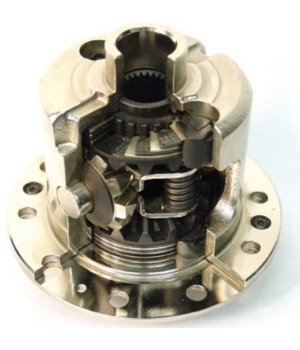
Helical (Torsen) LSD
A helical LSD, also known as a Torsen (Torque-Sensing) differential, uses a set of worm gears instead of clutch plates. These gears automatically distribute power based on traction levels, making them highly effective for track racing and spirited street driving. Unlike clutch-type LSDs, helical differentials operate smoothly and require little maintenance.
Pros:
- Seamless power transfer with no abrupt locking
- No need for clutch replacements or maintenance
- Excellent for both performance and street driving
Cons:
- Less aggressive lock-up compared to clutch-type LSDs
- Not ideal for drifting, as it doesn’t provide instant lock-up
- More expensive than standard differentials

Viscous LSD
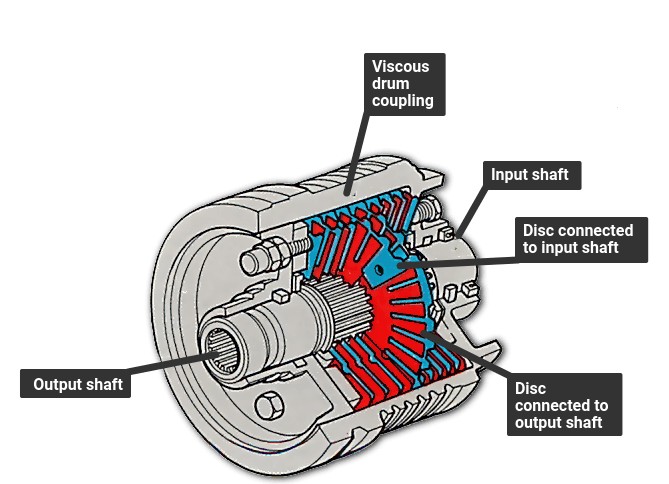
Viscous LSDs use a sealed chamber filled with a thick silicone-based fluid to transfer torque between the wheels. When one wheel spins faster than the other, the fluid heats up and thickens, gradually increasing torque transfer. This type of LSD was common in older performance vehicles but has largely been replaced by more advanced designs.
Pros:
- Smooth and quiet operation, making it ideal for street use
- Requires little maintenance compared to clutch-type LSDs
- Affordable compared to other LSDs
Cons:
- Slower response compared to clutch or helical LSDs
- Less effective in high-performance applications
- Cannot be easily adjusted or tuned
Differential Gear Ratio - The Secret to Acceleration
The differential gear ratio determines how torque is distributed and affects acceleration and top speed. A higher ratio (e.g., 4.10:1) provides faster acceleration but lowers top speed, while a lower ratio (e.g., 3.23:1) favors higher top-end speed but slower acceleration.
In simple terms, the gear ratio represents how many times the driveshaft rotates for each complete turn of the wheels. For example, with a 4.10:1 ratio, the driveshaft rotates 4.1 times for each wheel rotation, allowing for quicker acceleration at the expense of fuel economy and top-end speed.
How Gear Ratios Affect Performance
- Acceleration: A higher gear ratio increases acceleration, making it ideal for short bursts of speed in racing conditions.
- Fuel Efficiency: Lower gear ratios improve fuel economy by reducing engine RPM at cruising speeds.
- Tire Size Considerations: If you upgrade to larger tires, a higher gear ratio may be needed to maintain acceleration and power delivery.
Choosing the Right Gear Ratio
- For track racing: Shorter gears (higher ratio) improve corner exits and acceleration.
- For drag racing: High-ratio gears improve launch performance and quarter-mile times.
- For highway driving: Lower ratios maintain fuel efficiency and top speed while reducing engine stress.
- For off-roading: A higher gear ratio helps maintain power at low speeds, which is crucial for crawling over obstacles.

Best Aftermarket Differential Brands
If you’re considering an LSD upgrade, here are some top-rated brands:
- Quaife -Helical LSD with smooth performance
- XJX Parts– High-performance limited slip differential for superior traction and control
- Cusco -Popular in drifting and track racing
- Kaaz -Aggressive clutch-type LSD for hardcore racers
Installation & Maintenance Tips
Key Considerations for Installation
- Ensure compatibility with your vehicle’s axle, transmission, and existing drivetrain components. Incorrect fitment can lead to performance issues or mechanical failures.
- Some LSDs require professional tuning for optimal performance, including setting preload, backlash, and engagement characteristics. Consider consulting an experienced mechanic or performance shop.
- Upgrading to a stronger driveshaft, axle shafts, and reinforced differential mounts may be necessary for high-power builds to prevent premature failure.
- If switching from an open differential, additional components such as specific bearings, seals, or custom driveshafts may be required for proper installation.
- Double-check torque specifications and use thread-locking compounds where necessary to ensure bolts remain secure under extreme driving conditions.
Maintaining Your Differential
- Use high-quality differential fluid (Motul, Red Line, Amsoil) to reduce wear, prevent overheating, and ensure smooth operation. Consider using an LSD-specific fluid if required by the manufacturer.
- Regularly inspect and replace worn clutch plates in clutch-type LSDs, as degraded plates can reduce performance and cause inconsistent power distribution.
- Change differential fluid at recommended intervals, especially after track days or heavy driving conditions, to prevent metal shavings and debris from causing damage.
- Avoid excessive wheel spin, as this can overheat and prematurely wear out LSD components, particularly in clutch-based systems.
- Listen for unusual noises such as whining, grinding, or clunking, which could indicate wear or improper installation. Address issues promptly to prevent further damage.
- For off-road or extreme-performance applications, consider periodic teardown inspections to check for internal wear and tear, ensuring peak performance and longevity.
Conclusion: Transform Your Driving Experience
A well-chosen differential upgrade can elevate your car’s performance, whether on the street, track, or off-road terrain. By selecting the right LSD and gear ratio, you can maximize traction, handling, and power delivery to match your driving style. Investing in a high-quality differential not only enhances performance but also adds value to your build.
