
Before talking about the LSD component, it is important to first understand the function and working principle of the open differential.
Differential Basics
The steering design of modern vehicles is based on the Ackermann principle, where the steering angle of the inner wheel during a turn is greater than that of the outer wheel. Using trigonometry, it can be calculated that the distance traveled by the inner wheel is shorter than that of the outer wheel.
Importance of Differential in Steering Control
When there’s a difference in distance, it means the rotational speeds of the inner and outer wheels (left and right wheels) are not the same. If the drive shaft output from the transmission does not utilize a differential to separate the left and right outputs, the vehicle would be unable to adjust the rotational speeds of the left and right wheels during a turn. At low speeds, the vehicle may compensate for this with excess and improper friction, but at high speeds, turning could cause the inner wheel to lift off the ground due to excessive rotation and friction, which in turn causes the axle and suspension to lift the vehicle body. When the inner side of the vehicle body lifts and centrifugal force acts on it, the vehicle naturally tends to roll over towards the opposite direction of the turn.
Therefore, the left and right wheels of the vehicle are definitely not coaxial, especially modern cars are mostly front-wheel drive design. Without a differential structure, the driver cannot control the steering wheel at all, because as long as the driver turns the steering wheel, the feedback force generated by the tire from the ground will strongly push the steering wheel back to the center origin, so control is impossible. Therefore, placing a differential in the center of the drive wheel is an essential component of the transmission system.
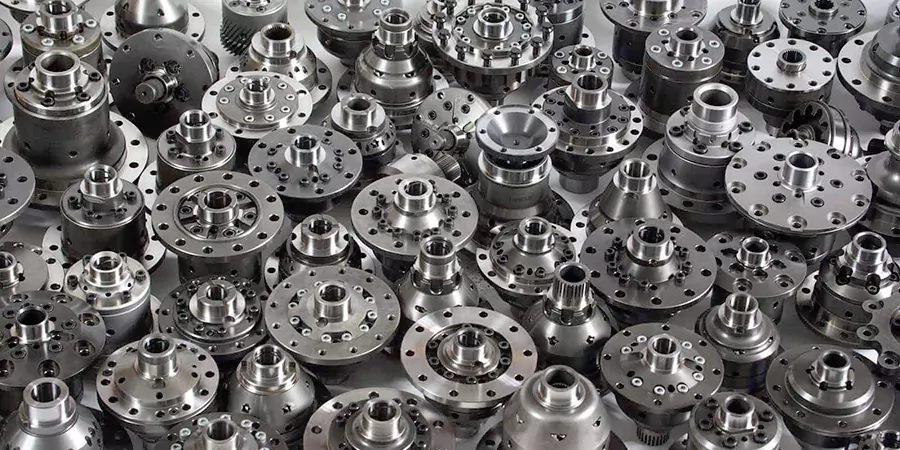
Since the differential is driven by the ring gear, it contains side gears and spider gears within it. When the vehicle is moving straight, the differential doesn’t engage; the spider gears and side gears simply rotate along with the ring gear without any differential action. However, when the vehicle turns and the resistance between the inner and outer wheels differs, the differential gears are forced to rotate independently due to the resistance, adjusting the speed of the left and right wheels. Since the change and adjustment of the wheel speeds are freely generated based on the resistance between the tires and the ground, the resulting conditions may lead to a situation where the vehicle is unable to move.
For example, when one wheel of a vehicle falls into a pothole, that wheel loses all traction, while the other wheel on the ground experiences significant resistance. At this moment, the differential will direct all the power to the wheel with low traction. The wheel that fell into the pothole will keep spinning, while the wheel on the ground remains stationary, rendering the vehicle unable to move.
As the performance output phenomenon, occurs when the wheels receive a significant power boost during cornering, often with heavy throttle application. The combination of torque output and centrifugal force causes the inner wheel to lift off the ground or slip. Once one wheel begins to spin freely, power is continuously transmitted to the spinning wheel (due to the reduced resistance), resulting in the vehicle being unable to accelerate forward.
Another type of slipping occurs under aggressive driving conditions, where the vehicle is neither turning nor is it on a surface with different friction coefficients for the left and right wheels. This situation arises during a drag race (0-400m acceleration), where massive power output, combined with slight differences in the lengths of the left and right drive shafts and tire variances, causes power to be instantaneously directed to the wheel with less traction. This wheel starts spinning uncontrollably, while the other wheel remains ineffective, preventing the vehicle from moving forward. To address these issues and ensure more even power distribution to the left and right drive wheels, limiting the differential’s slip ratio between the left and right wheels is essential. This is where the limited-slip differential (LSD) comes in as the standard solution to the problem.
