
The differential is a device used to distribute power or torque between the vehicle’s tires so that the left and right tires can rotate at different speeds while the vehicle is moving. This different rotation speed maintains the stability of the vehicle in corners, uneven road surfaces, etc., and allows the vehicle to adapt to different driving conditions in the best way.
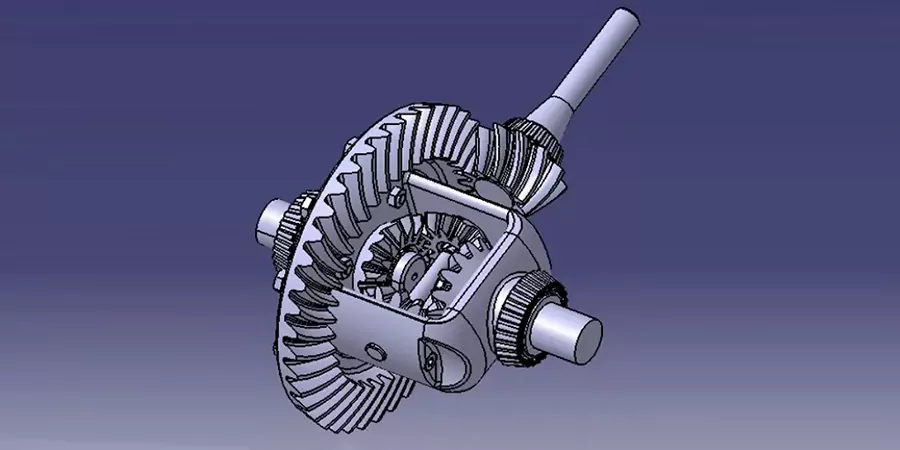
Open Differential
An open differential is the most basic type of differential and works on the principle of allowing the two tires to rotate at different speeds when needed. When driving in a straight line, an open differential allows both tires to rotate at the same speed, but when turning, it allows the inside tire to slow down to accommodate the radius of the turn. However, an open differential can result in a large loss of torque in certain situations, such as when one tire loses traction.
Limited Slip Differential
The limited slip differential is designed to compensate for the shortcomings of an open differential in situations of insufficient adhesion or slip. It does this by using some friction or mechanical devices to increase the torque distribution between the two tires. This allows the limited slip differential to suppress tire slip to some extent, providing better traction. Limited slip differentials perform well in off-road driving or on low-grip surfaces.
Locking Differential
Locking differential allows the driver to manually or automatically lock the differential between the two tires when desired. In the locked state, both tires will be forced to rotate at the same speed regardless of the road conditions. This is very useful for overcoming extreme uneven roads or traps, but may cause instability when turning.
Limited Slip Differential vs. Locking Differential
There are obvious differences between limited slip differentials and differential locks in terms of function and usage scenarios. In general, each has its own advantages and disadvantages, and there is no absolute distinction between good and bad. Instead, they are suitable for different driving needs and road conditions.
The main function of the limited slip differential is to limit the speed difference between the two tires to ensure that the vehicle can turn smoothly and stably. It is suitable for ordinary civilian vehicles. When the vehicle turns, it automatically adjusts the rotation speed of the left and right tires to cope with turning paths of different lengths.
The differential lock is a higher-level differential control device, mainly used to cope with more complex road conditions and driving needs. When the vehicle encounters extreme road conditions, such as when one wheel loses grip, the differential lock can quickly intervene and lock the speed of the left and right wheels to ensure that the vehicle can continue to move forward.
Conclusion
In summary, for general driving needs and road conditions, the limited slip differential is sufficient to meet the needs. But in the face of more extreme road conditions and driving needs, the differential lock can play a better role. Therefore, when choosing to use a limited slip differential or a differential lock, you need to weigh it according to your actual needs.
