Why Your Performance Car Needs a Limited-Slip Differential?

On a bright Sunday afternoon at the track, you’re eager to show off what your car can do. You roll into the burnout box, drop the clutch, and floor it. But instead of a satisfying cloud of smoke from both rear tires, only one wheel spins furiously while the other stays still. Onlookers start laughing — and suddenly, you’re “that guy.”
What went wrong?
You’re running an open differential.
Before diving into the solution — limited-slip or locking differentials — let’s revisit why differentials exist in the first place, and why a performance car deserves something better than the basic open diff.

The Purpose of a Differential
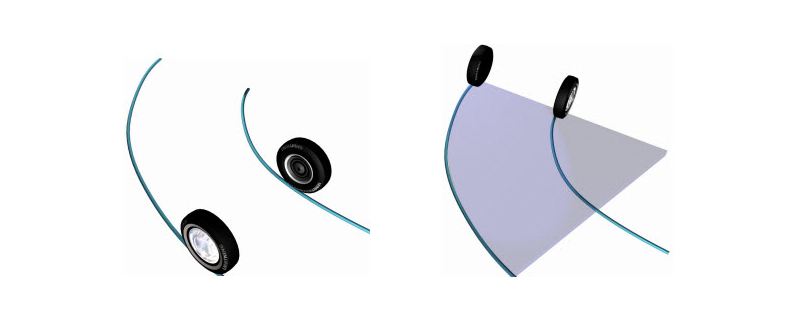
Purpose of a Differential
A differential is a mechanical device that compensates for the difference in wheel speed between the left and right tires of a driven axle. This difference occurs most notably when a vehicle turns, as the outside tire must travel a longer path and thus rotate faster than the inside tire.
Without a differential, both wheels would be forced to rotate at the same speed, resulting in:
  • Tire hop or scrubbing during turns
  • Increased drivetrain stress
  • Potential axle or shaft breakage

The Limitation of an Open Differential

An open differential handles turns well, but it fails when traction becomes uneven — for instance, when one tire is on asphalt and the other on gravel. In that situation, the open diff sends most of the power to the wheel with the least resistance — the one that’s already spinning uselessly.
In practical terms: One-tire fire. No traction. No movement.

Enter the Limited-Slip Differential (LSD)
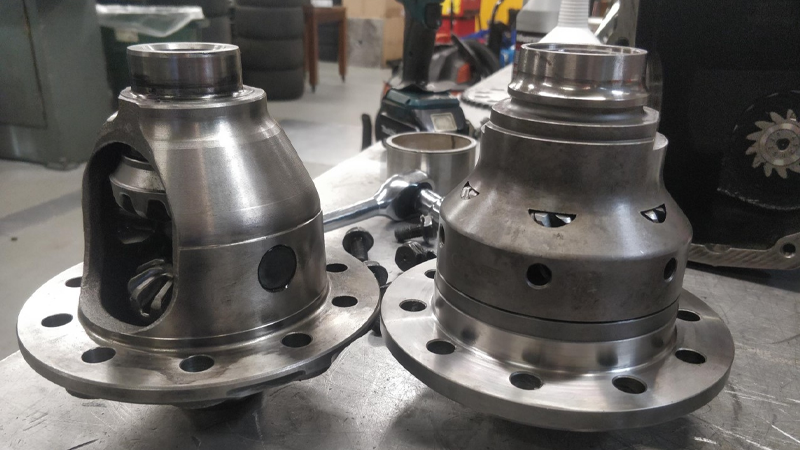
open diff vs LSD
A limited-slip differential is designed to overcome the shortcomings of the open differential by limiting the difference in rotational speed between the two wheels. When one tire begins to lose grip, an LSD shifts more torque to the tire with better traction. This results in:
  • Improved acceleration
  • Better cornering stability
  • Superior control in performance and off-road driving

Types of Limited-Slip Differentials

1.Clutch-Type LSD

Rebuildable: Yes
Maintenance: Requires friction modifier (hypoid additive)
This is the most common LSD found in factory muscle cars and aftermarket performance builds. It consists of:
  • A spring pack
  • Clutch discs
  • Modified side gears
How it works:
The spring preload pushes the side gears outward into the clutch packs. During normal driving, both wheels turn at the same speed, and there’s little friction. When one wheel slips, the clutch packs engage, applying friction to keep both wheels rotating together.

Advantages:

  • Widely available and cost-effective
  • Adjustable preload and lockup characteristics
  • Rebuildable and tunable
Disadvantages:
  • Clutches wear out over time
  • Heat and friction reduce long-term performance

Best for:
Street/strip cars, drift setups, and budget performance builds.

2. Cone-Type LSD

Rebuildable: Generally No
Maintenance: Requires friction modifier
Instead of clutch discs, cone LSDs use tapered cones that press into the differential case to create friction.

How it works:
The cone gears are splined to the axles. Under load, side and pinion gears force the cones outward into the case, creating friction that limits wheel speed difference. Preload is provided by a central spring.

Advantages:
  • Smooth engagement
  • Strong initial lockup
  • Better friction area than clutches

Disadvantages:

  • Non-rebuildable in most cases
  • Friction surfaces wear into the housing over time
  • Limited upgrade or tuning potential
Best for: Muscle cars, mild street performance, occasional track use.

3. Gear-Type LSD (Helical/Torsen)

Rebuildable: No
Maintenance: No additive required

This LSD type uses helical-cut gears rather than friction materials to manage torque split.

How it works:
A set of worm or spur gears mesh within the differential case. When both wheels have traction, torque is evenly split. When one wheel begins to slip, the difference in resistance causes the gears to wedge against the side gears, biasing torque to the wheel with grip.

Advantages:

  • Virtually maintenance-free
  • Smooth, seamless operation
  • No friction materials to wear out
  • Highly durable

Disadvantages:

  • Can lose effectiveness if one wheel is fully unloaded (e.g., airborne)
  • Bias ratio is fixed and not tunable

Best for:
High-performance street cars, autocross, track day builds, AWD systems.

What About Spools or Welded Diffs?

Some racers opt for a full spool or a welded diff to permanently lock the axle — both wheels rotate at exactly the same speed, all the time. This is dangerous on the street.
  • Tires scrub and hop during turns
  • Increased stress on axles
  • No differentiation = zero tolerance for street use
Best reserved for drag racing only.

Conclusion

If you care about traction, stability, and real performance — a limited-slip differential isn’t optional, it’s essential. Don’t let your horsepower go up in tire smoke from just one side — make sure your differential is working with you, not against you.
At XJXPARTS, we don’t just supply limited-slip differentials — we specialize in precision-engineered Torsen-style gear LSDs. Designed for maximum durability, zero maintenance, and smooth torque biasing, our worm-gear based units are trusted by professionals across racing, off-road, and OEM applications.

Whether you’re a performance tuner, 4×4 builder, or automotive distributor, our Torsen-style LSDs deliver the grip your vehicle deserves — without compromises. Contact us now.

Shopping Cart