
For decades, the word “Quattro” has been synonymous with superior traction and German engineering. If you own an Audi or are looking to buy one, you have likely heard enthusiasts arguing about which system is “true” Quattro. The reality is that Audi uses several different technologies under the same badge. The two most prominent are Torsen and Haldex.
While both systems aim to provide grip in slippery conditions, they operate on completely different mechanical and philosophical principles. One is a purely mechanical, permanent system, while the other is an electronically controlled, on-demand solution. Understanding the difference is crucial for anyone interested in vehicle dynamics, maintenance, or performance upgrades.
What is Torsen Quattro?
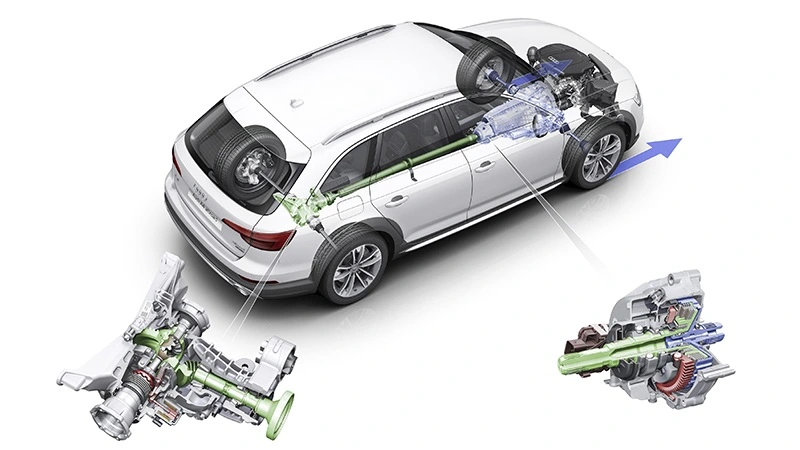
The Torsen system is what most purists refer to as “real” Quattro. The name stands for “Torque-Sensing.” It is a purely mechanical center differential that has been the backbone of Audi’s longitudinal engine platforms—like the A4, A6, and A8—for generations.
In a Torsen-based vehicle, the engine is mounted North-South (longitudinal). This layout allows the gearbox to sit directly behind the engine, with a center differential distributing power to both the front and rear axles simultaneously. Because it is mechanical, there are no clutches to engage or electronic pumps to prime. It is always “on.”
The magic of Torsen lies in its worm gear architecture. It uses the friction generated between gears to “sense” torque. When it detects that one axle has less resistance (due to slipping), the gears naturally bind and redirect torque to the axle with more grip. This happens instantaneously because it relies on the laws of physics rather than a computer processing sensor data.
What is Haldex Quattro?
Haldex is a very different beast. It is primarily found in Audi’s transverse engine models (where the engine sits East-West), such as the A3, Q3, and the TT. Because these cars are based on a front-wheel-drive architecture, there isn’t enough physical space for a massive Torsen center differential.
Instead of a mechanical center diff, Haldex uses a multi-plate wet clutch pack located at the rear axle. Under normal driving conditions, the car is effectively front-wheel drive. This saves fuel and reduces wear on the drivetrain. When the onboard computer detects front-wheel slip via the ABS and ESC sensors, it engages an electric pump to apply hydraulic pressure to the clutch plates. This connects the rear wheels to the driveshaft, providing all-wheel-drive capability.
Modern iterations, like the Haldex Gen 5 and Gen 6, have become incredibly fast. They are now “proactive,” meaning they can engage the rear wheels based on throttle position and steering angle before the slip even occurs. However, at its core, it remains an “on-demand” system rather than a permanent one.
The Mechanical vs. Electronic Trade-off
The debate between Torsen and Haldex usually boils down to a choice between mechanical purity and electronic efficiency.
Torsen is favored by performance drivers because of its predictability. Since power is always going to all four wheels, the car feels more balanced during mid-corner acceleration. There is no sudden “shove” from the rear as a clutch engages. It provides a consistent, heavy-planted feel that is difficult to replicate with electronics. Furthermore, because it is purely mechanical, it is incredibly robust. There are no sensors to fail and no electronic control modules to glitch out.
Haldex, on the other hand, is significantly more efficient. By disconnected the rear wheels when they aren’t needed, the car experiences less parasitic drag, leading to better miles-per-gallon (MPG). It is also much lighter than a Torsen setup. For a compact car like an Audi S3, the weight savings and fuel efficiency are major advantages for a daily driver. The downside is that it can sometimes feel reactive, and the ” Haldex kick”—the feeling of power suddenly shifting to the rear—can be distracting for track enthusiasts.
Engine Layout: The Defining Factor
You cannot simply choose which system you want on a specific Audi model; the choice is dictated by the engine’s orientation.
- Longitudinal Engines (Torsen): These are usually larger vehicles. The engine sits forward of the front axle, and the transmission extends back into the transmission tunnel. This layout is designed for high torque and better weight distribution.
- Transverse Engines (Haldex): These are compact cars. The engine sits sideways in the engine bay. This layout is designed to maximize interior cabin space and is typical of vehicles shared with the Volkswagen Golf platform.
This is why an Audi A4 (Torsen) and an Audi A3 (Haldex) drive so differently, even though they both have “Quattro” written on the grille.
Maintenance and Long-term Reliability
From a maintenance perspective, Torsen is almost “fit and forget.” It shares its oil with the transmission in many cases or has its own dedicated gear oil. As long as the seals aren’t leaking and you change the gear oil every 60,000 to 80,000 miles, a Torsen unit will often outlast the engine.
Haldex requires a much more strict maintenance schedule. Because it uses a wet clutch pack, the friction material eventually contaminates the hydraulic fluid. Audi typically recommends a Haldex fluid change every 30,000 miles. In older generations, there is also a filter that needs to be replaced. If you neglect this, the small pump that engages the rear wheels can burn out, leaving you with a front-wheel-drive car and a dashboard full of warning lights.
For a used car buyer, a Torsen-equipped Audi is generally considered the safer bet for high-mileage longevity. A Haldex car with no service history is a potential liability, as the AWD system may already be compromised by dirty fluid or a failing pump.
Real-World Performance: Snow, Rain, and Track
When it comes to actual performance, the gap between the two has narrowed in recent years.
In deep snow, both systems are excellent. While Torsen is permanent, Haldex engages so quickly now that most drivers won’t notice the delay. However, Torsen has a slight edge in “engine braking.” When you downshift on a slippery hill, Torsen applies that braking force to all four wheels mechanically. In a Haldex car, the engine braking is mostly applied to the front wheels unless the system decides to engage the clutches.
On a dry track, Torsen remains the king of corner exit. It naturally wants to bias torque to the rear (often 40:60), which helps the car rotate and prevents the “plowing” understeer common in front-biased cars. Haldex systems, even in performance models like the RS3, still have a tendency to feel like a front-wheel-drive car that is trying its best to be AWD.
The Zero Torque Issue
One technical quirk of the Torsen system is the “zero torque” problem. Because Torsen is a torque multiplier, it needs some resistance to work. If you jack up one wheel or put one wheel on a sheet of perfectly smooth ice (zero traction), the Torsen differential can sometimes act like an open differential, sending all power to the spinning wheel.
Audi solves this using EDL (Electronic Differential Lock), which uses the brakes to create “fake” resistance on the spinning wheel, allowing the Torsen gears to bind and move the car. Haldex does not have this specific problem because it uses a physical clutch pack to lock the axles together regardless of individual wheel resistance.
Why the Choice Matters to You
If you are a driving enthusiast who values mechanical feedback and plans on keeping your vehicle for a long time, the Torsen-based Quattro systems found in the A4 and up are likely your best match. They offer a “classic” AWD feel that is becoming increasingly rare in the age of electrification.
If you prioritize fuel economy, interior space, and modern tech in a compact package, a Haldex-equipped Audi is more than sufficient. For 99% of daily driving scenarios—rainy highways, gravel driveways, or light snow—Haldex is a highly capable and intelligent system.
The “Torsen vs. Haldex” debate isn’t about which one is “bad”; it’s about understanding that Audi uses the best tool for the specific chassis. Both systems have defined the brand’s identity and continue to set the standard for all-wheel-drive performance across the globe.
At XINJIN Auto Parts, we specialize in the high-quality driveline components that keep these legendary systems running. As a professional factory, we provide precision-engineered differentials, ring and pinion sets, and lockers for various automotive applications. If you need expert support or parts, feel free to contact us anytime.
