
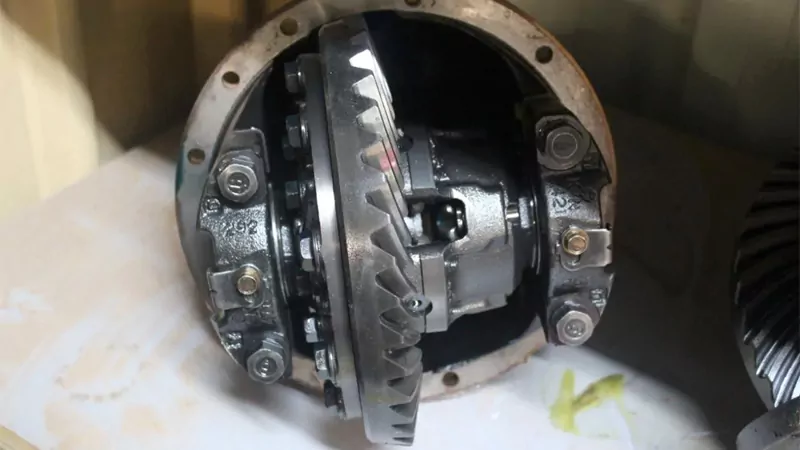
Understanding the Fundamentals of Traction
However, the fatal flaw of an open differential is that it sends torque to the path of least resistance. If one front tire is on ice or lifted in the air, the open differential will spin that tire uselessly while the tire with grip receives no power. This is where Lockers and LSDs come into play.
What is a Front Locker?
A Front Locker (or locking differential) is a mechanism that physically bridges the two axle shafts together. When engaged, it forces both front wheels to turn at the exact same speed, regardless of the traction available to each individual tire.
The Different Types of Front Lockers
- Selectable Lockers: These are the gold standard for front axle applications. Controlled by the driver via a switch in the cab, they can be “Open” for street driving and “Locked” when the terrain gets tough. They usually operate via air (pneumatic) or electricity (solenoid).
- Automatic (Lunchbox) Lockers: These are mechanical devices that stay locked by default and “unlock” only when the torque load allows it during a turn. While cost-effective, they can be unpredictable in a front-axle application, especially in 4WD on high-traction surfaces.Automatic (Lunchbox) Lockers: These are mechanical devices that stay locked by default and “unlock” only when the torque load allows it during a turn. While cost-effective, they can be unpredictable in a front-axle application, especially in 4WD on high-traction surfaces.
- Spools: Not technically a locker, but a solid piece of metal that permanently connects the axles. These are strictly for dedicated competition rigs and should never be used on the street or in a front axle of a general-purpose vehicle.
Advantages of a Front Locker
The primary benefit is uncompromising traction. If you have a Front Locker engaged, as long as one front tire has traction, your vehicle will move forward. This is indispensable for rock crawling, where lifting a tire is common, or in deep mud where consistency is key.
Disadvantages of a Front Locker
The most notable drawback is the impact on steering. Because both front tires are forced to rotate at the same speed, the vehicle will naturally want to drive in a straight line. Turning becomes much more difficult, and the stress on your CV joints or U-joints increases significantly.
What is an LSD (Limited Slip Differential)?
A Limited Slip Differential (LSD) serves as a middle ground between an open differential and a full locker. Instead of a hard mechanical lock, an LSD uses friction (via clutch packs or gears) to transfer a portion of the torque from the spinning wheel to the wheel with more grip.
The Different Types of LSDs
- Clutch-Type LSDs: These use a series of friction plates and springs. When one wheel spins significantly faster than the other, the friction plates bind, transferring torque.
- Torsen/Helical LSDs: These use complex worm gears rather than clutches. They are torque-sensing and provide a much smoother, more progressive transfer of power. They are generally considered more “maintenance-free” than clutch types.
Advantages of an LSD in the Front
An LSD is far more “user-friendly” than a locker. It is always active, requiring no driver input, and it allows for much smoother steering. In high-speed off-roading, desert racing, or driving on snowy/icy roads, an LSD provides enhanced grip without the harsh mechanical “jerk” or steering resistance of a locker.
Disadvantages of an LSD in the Front
An LSD is not a 100% lock. If one wheel is completely off the ground, a traditional LSD may still struggle to provide enough torque to the stationary wheel to move the vehicle. Furthermore, clutch-type LSDs wear out over time and require special friction-modifier additives in the gear oil.
Front Locker vs. LSD: A Detailed Comparison
To decide which is right for your build, we need to compare them across several critical categories.
1. Off-Road Performance
In extreme technical environments like rock crawling or crossing deep ruts, the Front Locker is the undisputed king. The ability to guarantee power to both wheels is vital.
The LSD shines in “low-traction but high-speed” scenarios. Think of a gravel road or a snowy highway. In these cases, you want the front end to help pull you through the turn without losing the ability to steer accurately.
2. Drivability and Street Manners
If your vehicle spends 90% of its time on the pavement, an LSD is much more comfortable. It is virtually invisible during daily driving.
A Selectable Front Locker is also excellent for the street because, when turned off, the differential acts like a standard open diff. However, an Automatic Front Locker can be harsh, causing “clunking” sounds or “binding” during tight turns in a parking lot if the hubs are locked.
3. Mechanical Stress and Longevity
Lockers place a tremendous amount of stress on the front drivetrain. Axle shafts, hubs, and steering components are all under increased load when the front end is locked.
LSDs are gentler on the vehicle. Because they allow for some “slip,” they act as a buffer for the drivetrain. However, as mentioned, clutch-based LSDs are wear items and will eventually need a rebuild. Gear-driven (Helical) LSDs are much more durable in the long run.
4. Installation and Cost
Generally, a high-quality selectable locker (like an Air Locker) is more expensive than an LSD. It requires not only the unit itself but also a compressor or electrical wiring. An LSD is usually a “drop-in” replacement for the factory carrier and is often more budget-friendly for those looking for a “set it and forget it” solution.
To help you visualize the core differences between these two systems at a glance, we have summarized their performance characteristics in the comparison table below:
| Comparison Factor | Front Locker (Selectable/Auto) | Limited Slip Differential (LSD) |
|---|---|---|
|
Off-Road Capability |
Superior; 100% torque to both wheels |
Moderate; requires some wheel spin to engage |
|
Drivability & Steering |
Heavy steering; tends to push straight |
Smooth; minimal impact on steering feel |
|
Mechanical Stress |
High load on axle shafts and CV joints |
Lower stress; acts as a drivetrain buffer |
|
Installation & Cost |
Generally higher (requires air/electric setup) |
Mid-range; usually a direct carrier replacement |
|
Ideal Terrain |
Rocks, deep ruts, and extreme inclines |
Snow, ice, gravel, and high-speed desert |
How to Choose Based on Your Terrain
Your choice should ultimately be dictated by where you drive most often:
- The Rock Crawler: If you spend your weekends on trails like the Rubicon or Moab, a Front Locker is non-negotiable. You need that 100% torque split to overcome vertical obstacles.
- The Overlander: If you travel long distances on varied terrain (dirt, mud, sand), a Front LSD or a Selectable Locker is ideal. Most overlanders prefer a selectable locker so they have the option for “overkill” if a trail gets unexpectedly difficult.
- The Winter Daily Driver: If you live in an area with heavy snow and ice, a Front LSD (specifically a Helical/Torsen type) is often superior. It provides better lateral stability on slippery roads compared to a locker, which can cause the front end to “wash out” or slide sideways on off-camber icy turns.
- The Desert Racer: High-speed sand and silt require momentum. An LSD allows for high-speed cornering and better “turn-in” than a locker.
Installation Considerations: Crown Wheels and Pinions
Regardless of whether you choose a Front Locker or an LSD, the installation process is the perfect time to inspect your Crown Wheel and Pinion (Ring and Pinion). Since the differential carrier must be removed to install the new traction device, many owners choose to re-gear their vehicle at the same time.
Upgrading to a higher gear ratio can help compensate for larger tires, restoring the vehicle’s power band and fuel economy. Ensuring that your gears are high-quality and professionally shimmed is critical to the longevity of your new locker or LSD.
Technical Maintenance Tips
To keep your front differential performing at its peak, follow these maintenance guidelines:
- Fluid Changes: Differential fluid should be changed more frequently if you submerge your axles in water or mud.
- Inspection: For those using lockers, regularly check your U-joints and CV boots. The added torque of a locked front end can accelerate wear on these components.
- Testing: Periodically engage your selectable locker on a straight, soft surface (like grass or dirt) to ensure the seals and solenoids are functioning correctly.
Summary: Making the Final Call
The choice between a Front Locker and an LSD isn’t about which part is “better” in a vacuum; it’s about which part is better for your specific application.
- Choose a Front Locker if you prioritize absolute capability and are willing to manage the steering characteristics and extra cost.
- Choose an LSD if you want improved traction with a focus on smooth handling, snowy roads, and a simpler mechanical setup.
The front axle is a critical part of your 4WD system. By upgrading the differential, you are transforming your vehicle from a standard commuter into a capable machine ready to tackle the elements.
Conclusion
When upgrading your drivetrain, quality and precision are paramount. At XinJin Auto Parts, we are a specialized factory providing high-performance differentials, LSDs, and crown wheel and pinion sets. If you need expert advice or durable parts for your vehicle, please feel free to contact us today.
