
A differential is a crucial component in a vehicle’s drivetrain, responsible for distributing power to the wheels while allowing them to rotate at different speeds. This function is essential, especially when turning, as the inner and outer wheels travel different distances. Without a differential, a vehicle would experience excessive tire wear and poor handling.
There are several types of differentials, each designed to enhance performance, efficiency, and traction under various driving conditions. In this article, we will explore the different types of differentials, their unique characteristics, and their applications in modern vehicles.

Open Differential
The Open Differential is one of the most common types of differentials found in everyday passenger cars and economy vehicles. It efficiently splits the engine torque in half and allows each wheel to rotate at different speeds, making it an essential component for smooth driving on standard roads.
Pros
- Simple Design and Cost-Effective: The open differential features a straightforward mechanical design, which results in lower manufacturing and maintenance costs, making it ideal for daily driving.
- High Durability: Without the complexity of limited-slip or locking mechanisms, this differential experiences less wear and tear, ensuring a longer service life.
- Smooth Torque Distribution: It provides consistent and balanced torque distribution, contributing to a stable and comfortable driving experience.

Cons
- Low Traction in Slippery Conditions: In low-traction environments, such as wet roads or off-road terrains, the open differential tends to deliver power to the slipping wheel rather than the one with better grip. This can result in wasted torque and may prevent the vehicle from moving forward.
- Suboptimal for High-Performance Driving: During high-speed cornering, the open differential is less effective at adjusting torque distribution. This limitation can lead to understeer or oversteer, negatively affecting vehicle handling and overall performance.
Applicable Vehicles
Open differentials are typically found in economical passenger cars and regular SUVs. They are best suited for urban roads and highways, where conditions are predictable and stable. However, they are not ideal for high-performance driving or extreme off-road environments due to their traction limitations.
Limited Slip Differential (LSD)
A Limited Slip Differential (LSD) is an enhanced differential system that overcomes the traction shortcomings of an open differential. It optimizes torque distribution in low-traction conditions and prevents excessive wheel spin, ensuring better overall performance and stability.
Types of LSD
Clutch-Type LSD: Utilizes friction clutch packs or helical gears to limit the speed difference between the wheels.
Advantages:
- Quick Response: Delivers rapid torque transfer, providing improved traction in various driving conditions.
- Versatility: Ideal for racetracks, performance sedans, and some off-road vehicles.
Disadvantages:
- Maintenance Requirements: Requires regular upkeep as the clutch plates wear over time.
- Low-Speed Issues: May produce a jerky sensation during low-speed driving, potentially affecting ride comfort.
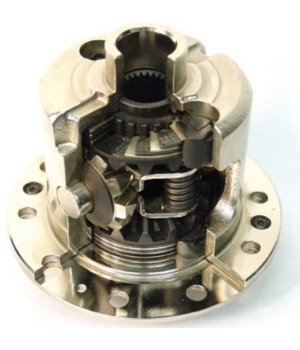
Torsen LSD: Employs a gear-based system to automatically distribute torque according to the grip levels of each wheel.
Advantages:
- Seamless Torque Adjustment: Offers highly responsive and smooth torque redistribution, enhancing vehicle stability.
- Robust and Durable: Its solid construction ensures long-lasting performance.
Disadvantages:
- Higher Cost: The complex manufacturing process results in a higher production and repair cost.
- Traction Limitations: When one wheel is completely off the ground and loses all traction, the Torsen differential might not fully perform its function.

Pros
- Enhanced Traction: When one wheel loses grip, an LSD limits power loss by transferring some torque to the wheel with better traction, preventing excessive wheel spin.
- Improved Handling: During high-speed maneuvers, an LSD allows the outer wheel to receive more power, increasing stability and reducing issues like understeer or oversteer.
Cons
- Higher Cost: Compared to open differentials, LSD systems are more complex, leading to increased production and maintenance expenses.
- Increased Maintenance Needs: Some LSD types rely on friction plates or viscous fluids that can wear over time, necessitating regular maintenance or periodic replacement.
Applicable Vehicles
Limited Slip Differentials are commonly used in high-performance sedans, sports cars, SUVs, and high-end off-road vehicles. These vehicles typically operate on racetracks or highways but can also handle light off-road and more challenging terrains. Additionally, LSD systems are increasingly found in vehicles like performance-oriented pickups, light-duty trucks, and even heavy-duty trucks where enhanced traction and improved handling are critical.
Locking Differential
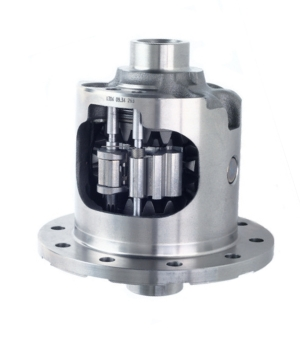
A Locking Differential, sometimes referred to as a “welded differential,” is designed to link the wheels together so that they rotate at the same speed. Under normal conditions, it functions similarly to an open differential. However, when needed, it can lock the wheels to ensure maximum traction.
Depending on the operating mode, locking differentials can be categorized into manual locking or automatic locking types. If you frequently drive in extreme off-road conditions, a manual locking differential is often the preferred choice due to its precise control. On the other hand, if convenience and versatility are more important, an automatic locking differential is the better option.
Pros
- Improved Traction:Locking differentials provide enhanced traction by locking both axles together. This ensures that all driven wheels receive equal torque, which is especially beneficial on low-grip surfaces such as mud, sand, or slippery roads. It prevents one wheel from spinning uselessly, maximizing overall traction.
- Enhanced Stability and Safety:By ensuring that power is evenly distributed across the wheels during challenging conditions, locking differentials enhance vehicle stability and safety, particularly when tackling rugged terrain.
Cons
- Impact on Handling:In normal driving conditions or during cornering, a locked differential can make turning more difficult or reduce overall maneuverability, potentially affecting the vehicle’s handling.
- Higher Cost: Locking differentials, especially the automatic variants, typically increase the vehicle’s cost due to their complex design and additional components.
Applicable Vehicles
Locking differentials are widely used across a range of vehicles that are expected to operate in complex or extreme conditions. This includes: Light-duty trucks, Pickups, Heavy-duty trucks, Off-road vehicles, SUVs, All-wheel drive (AWD) vehicles.
These vehicles often require extra traction to navigate challenging terrains such as mud, sand, and rugged mountain paths.
Torque-Vectoring Differential
The Torque-Vectoring Differential is an advanced differential system that dynamically distributes torque along the drive axle based on road conditions and driving demands. Unlike traditional differentials that merely control the rotation speeds of the left and right wheels, a torque-vectoring differential intelligently allocates power to each individual wheel. This advanced technology significantly improves vehicle handling, stability, and traction, especially when cornering.
Pros
- Optimized Handling and Driving Experience:By intelligently distributing torque, the system minimizes understeer or oversteer and adjusts power distribution in real-time to suit varying driving conditions, leading to a smoother and more controlled driving experience.
- Enhanced Traction and Reduced Wheel Spin: The differential helps reduce wheel spin by directing power to the wheel with the most grip, which improves traction and enhances the vehicle’s ability to navigate challenging terrains.

Cons
- Higher Cost: The complex integration of electronic controls and mechanical components in a torque-vectoring differential results in higher manufacturing and maintenance costs compared to conventional differential systems.
Applicable Vehicles
Torque-Vectoring Differentials are widely implemented in high-performance sports cars, SUVs, and all-wheel-drive vehicles. In recent years, this technology has also been increasingly adopted in premium pickup trucks, as well as light and heavy-duty trucks. Vehicles that demand superior traction and handling, such as the Ford F-150 Raptor and Toyota Tacoma TRD Pro, benefit greatly from the improved off-road performance and load stability provided by this system.
Integrating a torque-vectoring differential not only enhances vehicle dynamics but also plays a crucial role in ensuring safety and performance across diverse driving conditions.
Electronic Differential
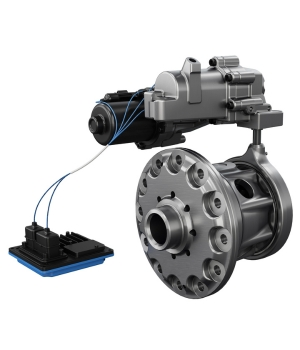
An Electronic Differential is typically found in electric vehicles (EVs) and hybrid vehicles. Instead of relying on a traditional mechanical differential, it achieves differential functionality by independently controlling the motor torque at each driven wheel. This modern system significantly improves efficiency and performance by eliminating mechanical losses.
Pros
- Enhanced Efficiency and Reliability:By eliminating the conventional differential, the system minimizes mechanical losses and improves overall efficiency. With fewer mechanical components, maintenance costs are reduced, and reliability is increased.
- Precise Power Control: The electronic differential provides highly accurate torque control, optimizing both handling and traction. This precise control enhances the driving experience and vehicle performance.
Cons
- Limited to Electric and Hybrid Vehicles: The technology is dependent on motor systems, making it suitable only for pure electric vehicles or hybrids. It is not applicable to traditional internal combustion engine vehicles.
- Complex Control System: The electronic differential requires a high-precision control system. This complexity leads to increased research, development, and production costs.
Applicable Vehicles
Electronic differentials are primarily used in modern vehicles equipped with advanced traction control systems. They are most commonly found in electric vehicles and hybrid models such as the Tesla Model S Plaid and Ferrari SF90 Stradale. This technology is a key innovation in the automotive industry, helping to drive the future of efficient and high-performance mobility.
Understanding the different types of differentials, from the basic Open Differential to the advanced Electronic Differential, allows automotive enthusiasts and professionals to appreciate the technology that enhances vehicle performance, traction, and handling. Each system, whether it is a Limited Slip, Locking, Torque-Vectoring, or Electronic Differential, offers unique benefits for various driving conditions.
Choosing the right differential is essential for optimizing your vehicle’s efficiency and safety on city streets, highways, and off-road terrains. Embracing these innovations drives automotive progress and delivers superior driving experiences.
XJX Auto Parts offers a wide range of differentials. If you are unsure which type best meets your needs, please contact us. Our professional team is ready to help you make the right choice.
