
In a typical family car, there is only one component called the differential, located between the left and right drive shafts to distribute torque. However, a regular differential is not an LSD—in terms of functionality and performance, the difference is like night and day. Simply put, an LSD allows the two drive shafts to rotate at different speeds while limiting the speed difference as much as possible. The key difference is that the LSD can finely adjust the speed difference, whereas a regular differential distributes torque at a relatively fixed, equal rate.
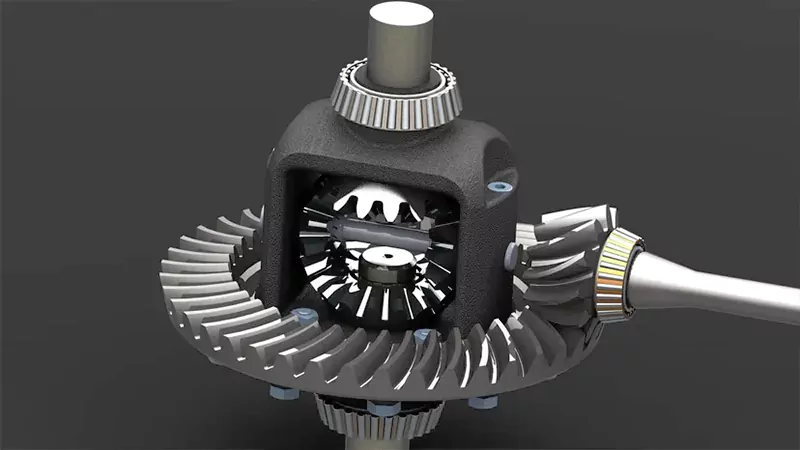
This is the original form of the open differential, which is installed in our vehicles, but it does not have the limited-slip function.
After briefly explaining what an LSD is, let’s look at the different types available. Passenger car LSDs are commonly divided into four categories: fixed type, torque type, speed type, and electronically controlled type. The fixed type, which first appeared in automobiles, is now rarely seen; the speed type has been used in very few models and is virtually extinct. The electronically controlled type seems to be the trend of the future, with notable applications in vehicles such as Subaru’s DCCD and various Porsche models. The two LSD forms we will focus on in this article belong to the torque type, which is the most common product in the automotive tuning field. Torque-type LSDs mainly come in two variants: friction-type and mechanical. Their parameters and operating methods are vastly different.


However, whether in original equipment or aftermarket upgrades, the mainstream product is not the friction-type LSD—since it is less convenient for daily use and tends to be noisy—but rather the mechanical type. The Torsen LSD, originally patented by American Vernon Gleasman, has evolved through three development stages: T1, T2, and T3. Currently, the T3 type, which utilizes a planetary gear structure, is the most widely used LSD. It is simple to maintain, quiet, and does not require special oil, making it more suitable for everyday driving. Many mass-produced cars come with a factory-installed Torsen LSD, including popular models such as the Toyota 86, Mustang GT, Megane RS, Peugeot 308 GTI, the later versions of the Mazda RX-8 (which entered the domestic market years ago), and the Lexus LC. However, the maximum lock-up rate of factory LSDs is lower than that of aftermarket Torsen mechanical LSDs; the factory versions are more focused on enhancing daily driving safety rather than extreme performance.
Conclusion
- Friction-type LSDs are classified as 2-way, 1.5-way, or 1-way.
- Mechanical LSDs are differentiated by the lock-up rate percentage.
