
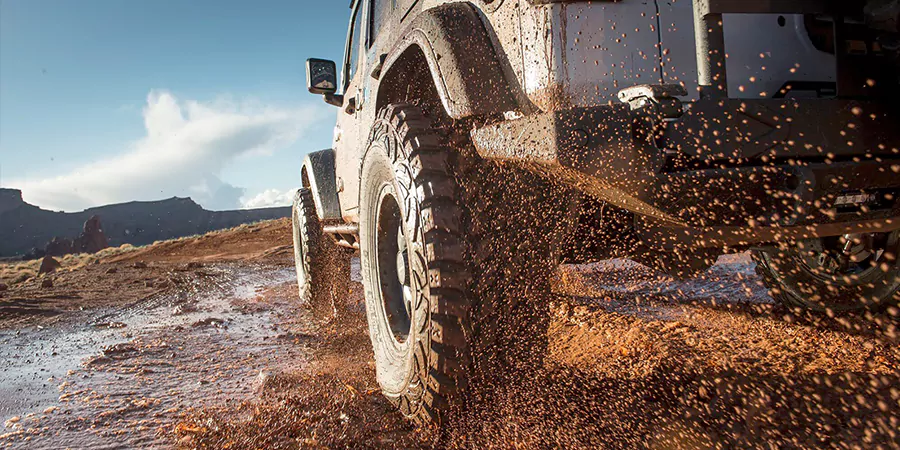
A limited slip differential helps you drive efficiently and safely. Sometimes, when driving on gravel or sand, one of the front wheels may get stuck. However, if you have a differential, you can keep driving and eventually get out of the jam. How does a limited slip differential work?
What is a limited slip differential?
A limited slip differential (LSD) divides the torque of the wheels and distributes it to the wheel with more traction. It is the most common differential in sports cars, trucks and SUVs.
Like an open differential, it allows the wheels to spin at different speeds but effectively transfers torque to the tire with higher traction when needed. However, the amount of torque transferred to one wheel is limited – that’s why it’s called “limited slip”. When one of the wheels loses traction completely, for example, it becomes difficult to keep balance and move.
What does a differential do?
A differential is a gear set that transfers torque from the engine to the wheels. It includes three shafts, the main shaft speed is the average of the other shafts. An open or traditional differential allows the wheels to rotate at different speeds, allowing the car to rotate.
However, a special problem arises when one of the wheels loses traction: one of the wheels gets more torque when it slips, while the other wheel almost stops and the vehicle cannot move. This situation usually happens after rain, when the road becomes wet and the wheels get stuck in puddles, or when one wheel is on sand and the other on asphalt. This is exactly where a slip differential comes into play.
What are the types of LSDs?
LSDs have a variety of design options for smoothly balancing the rotation of the wheels under different traction conditions. Generally speaking, there are two main types, torque-sensitive and speed-sensitive, which can distinguish between positive traction. The maximum possible difference between the torque inputs on the two wheels is called the deviation, and some LSDs have the deviation as a fixed value.
Torque-sensitive differentials
Torque-sensitive differentials are mechanical differentials that respond to the torque of the drive shaft. The most common of these is the clutch pack differential. The principle is that behind each differential side gear, there is a clutch plate pack. When one wheel starts to slip and the torque input changes, the load on the clutch pack increases and the power is smoothly transmitted to the other wheel.
This type of traction device is more expensive and complex and is usually used in sports cars to balance the extra power transmitted by the engine to the wheels for smooth starts.
Speed-sensitive differentials
Speed-sensitive differentials are triggered by the speed difference between the two outputs. The most common speed-sensitive differentials are called viscous LSDs. They use fluid dynamic friction of high viscosity fluids or silicone-based gels. These differentials look like cylindrical chambers filled with fluid, with a stack of perforated discs attached to the shaft, and the differential attached to the inner and outer surfaces. The movement of the differential causes friction on the discs, which heats up the gel. The heat causes the gel to expand and pull the discs together and “block” the speed difference on the wheels.
This LDS is easy to produce and works more gently, proportional to the slip, but requires more careful handling. The gel loses its quality over time and needs to be replaced every 60,000 miles. In addition, it is sensitive to overheating and becomes less effective whenever the car is stuck in snow or mud.
Conclusion
A limited-slip differential is essential for off-road and adverse driving conditions. It distributes torque to the wheel and allows it to spin when one of the wheels slips and partially loses traction. It makes up for the main disadvantage of an open differential, allowing the wheels to spin at different speeds until the allowed limit is reached.
A limited-slip differential stabilizes the vehicle, but it does not help in extreme situations where the car is stuck in mud or snow and one of the wheels completely loses traction.
